Let’s simplify carbon credits from start to finish.
Confuse..how carbon credits work, where they come from, and how they create real climate impact❓🤷♂️
Let’s simplify carbon credits from start to finish.
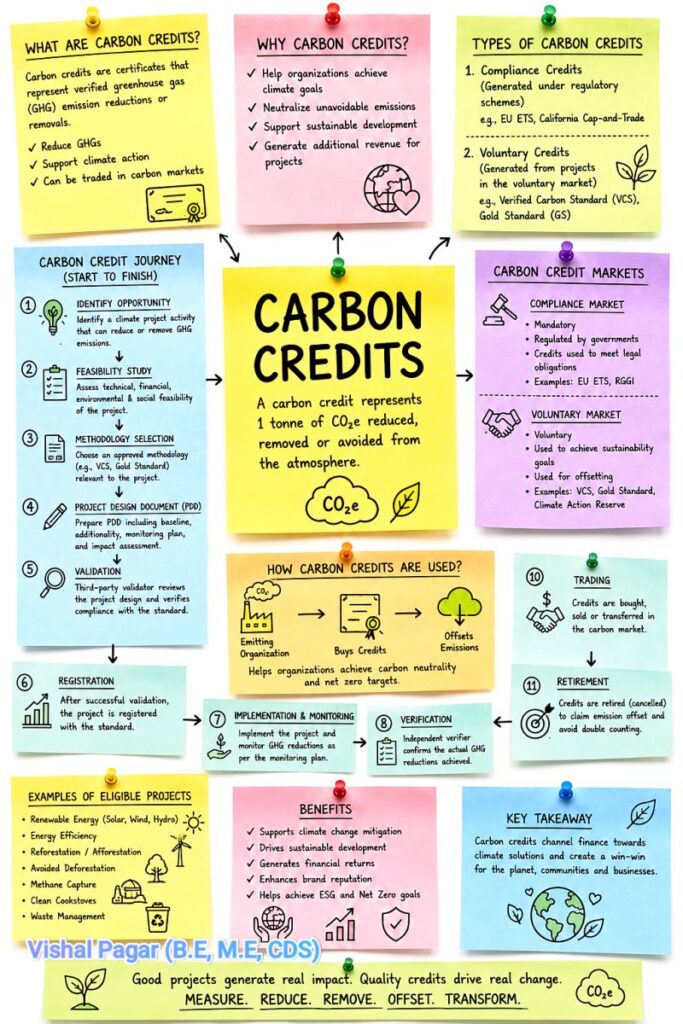
A carbon credit represents 1 tonne of CO₂ equivalent (CO₂e) reduced, removed, or avoided from the atmosphere.
But there is much more behind that simple definition.
Here is what you need to understand about carbon credits:
1. Why do carbon credits matter?
Carbon credits can help organizations:
* Support climate change mitigation.
* Address unavoidable emissions.
* Finance sustainable development projects.
* Contribute towards net-zero ambitions.
2. What are the two major types of carbon credits?
There are two important categories:
* Compliance credits: Generated or recognized under regulatory frameworks such as the EU ETS and California Cap-and-Trade.
* Voluntary credits: Generated through projects and purchased voluntarily by organizations to support climate action.
3. How are carbon credits generated?
A carbon credit project typically follows a structured process:
* Identify a climate-positive opportunity.
* Conduct a feasibility study.
* Select an approved methodology.
* Prepare a Project Design Document (PDD).
* Complete independent validation.
* Register the project with the relevant standard.
* Implement the project and monitor performance.
* Verify actual emission reductions or removals.
* Issue carbon credits.
* Trade the credits.
* Retire the credits to claim their use and prevent double counting.
4. What projects can generate carbon credits?
Some common examples include:
* Renewable energy projects.
* Energy efficiency improvements.
* Reforestation and afforestation.
* Avoided deforestation.
* Methane capture.
* Clean cookstoves.
* Waste management.
5. How are carbon credits used?
Organizations can purchase eligible carbon credits to support climate projects and address residual emissions as part of a broader climate strategy.
However, remember:
Carbon credits should not become an excuse to avoid reducing emissions within your own operations and value chain.
6. What makes a carbon credit valuable?
Not all carbon credits deliver the same level of environmental integrity.
A credible carbon credit should demonstrate:
* Additionality.
* Accurate quantification.
* Independent verification.
* Permanence, where relevant.
* No double counting.
* Robust monitoring and reporting.
The quality of the underlying project matters more than simply purchasing a credit.
The key takeaway:
Carbon credits are more than certificates or tradable commodities.
Measure. Reduce. Remove. Offset residual emissions. Transform.