
THE EVOLUTION OF CIVIC POWER
Most urban planning claims to be community-driven. In practice, it rarely gets past a one-way notification.
Traditional municipal governance often treats public engagement as a checklist item:
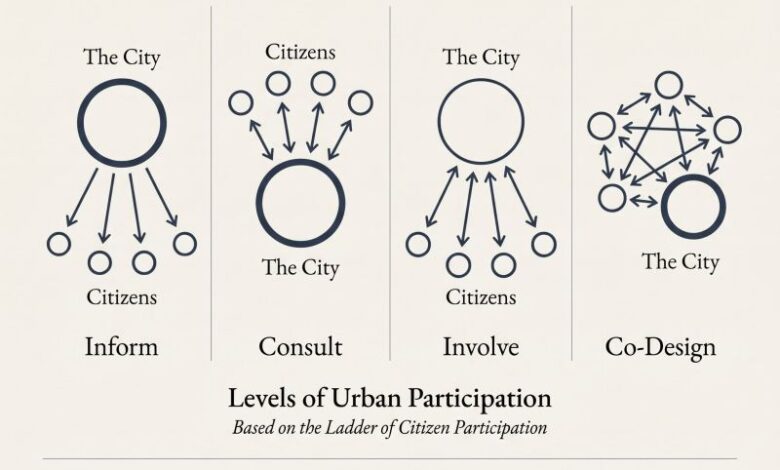
Inform: Transmitting decisions that have already been made.
Consult: Gathering feedback after the blueprints are drawn.
Involve: Engaging residents as external reviewers rather than equal decision-makers.
The shift outlined in the graphic captures The Evolution of Civic Power:
True urban systems innovation requires moving from passive informing to decentralized co-design, where citizens hold shared, collaborative power to shape their city.
When we limit civic engagement to consultative loops, institutions retain total control while communities bear the consequences of misaligned policies. Moving to genuine Co-Design replaces top-down hierarchies with distributed networks of agency, shared ownership, and local intelligence.
How can our cities transition from merely consulting the public to actively co-designing the future together?
What is the biggest operational hurdle you’ve seen when municipal governments attempt to share actual decision-making power with residents?


