Onboard Carbon Capture (OCC): Navigating Toward a Low-Carbon Maritime Future
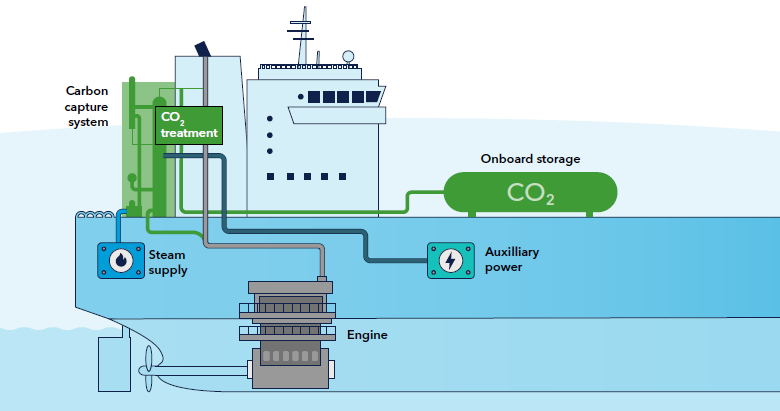
As global pressure mounts to reduce carbon emissions across all industries, the maritime sector finds itself at the center of the decarbonization debate. Onboard Carbon Capture (OCC) has emerged as a promising yet challenging solution for significantly reducing emissions from ships. At its core, OCC involves capturing carbon dioxide (CO2) directly from a ship’s exhaust, preventing it from being released into the atmosphere. This enables vessels to continue using conventional fuels while cutting their carbon footprint—an enticing prospect given the slow development of alternative, low-carbon fuels.
However, while OCC holds significant potential, it comes with a complex set of technical, economic, and regulatory challenges that must be overcome for it to become a viable long-term solution.
1. The Technical Balancing Act: Making OCC Work on Ships
OCC technology is not new; it has been applied on land in industries such as power generation and heavy manufacturing. However, its adaptation for maritime use presents unique technical challenges. Ships operate in dynamic environments with varying operational profiles, and integrating OCC systems onboard requires significant engineering ingenuity.
Several factors affect the feasibility of OCC on ships, including vessel size, available space for installation, and the capacity of the ship’s power and heat systems. For smaller vessels, retrofitting an OCC system may prove especially difficult due to space constraints, while larger ships, such as tankers or container vessels, offer more room for integration but face higher costs and energy demands.
The technical intricacies of integrating OCC systems with a ship’s existing machinery and power infrastructure raise critical questions: How can these systems be optimized to capture CO2 efficiently while minimizing energy consumption? How can they be adapted for different ship types and operational patterns? Answers to these questions will require further research and development in OCC technology, potentially transforming it from a promising concept into a practical solution.
2. Navigating Economic Headwinds: The Cost Barrier to OCC Adoption
Even if OCC can be made technically viable, its economic feasibility remains a daunting hurdle. The installation of OCC systems comes with a hefty price tag, and ongoing operational expenses can further erode the financial case for its adoption.
Additionally, the size of the equipment itself poses a challenge. Onboard capture systems are large and can reduce the space available for cargo, which in turn diminishes the revenue-generating capacity of the ship. For commercial shipping lines, where margins are tight and competition is fierce, the loss of cargo space can be a dealbreaker.
There’s also the issue of the “fuel penalty”—the increase in fuel consumption caused by operating the capture systems. OCC requires energy to function, meaning ships burn more fuel to capture CO2. The additional fuel costs can offset the benefits of emissions reduction, making OCC less attractive from an economic perspective.
For OCC to become economically viable, two critical developments are necessary. First, the technology must achieve high capture rates with minimal fuel penalties. Second, carbon pricing mechanisms, such as those emerging in the EU, need to make carbon capture more financially attractive by placing a higher price on emissions. Only then can shipowners justify the investment in OCC systems as part of a broader decarbonization strategy.
3. Regulatory Uncertainty: The Need for Global Standards
The regulatory landscape surrounding OCC is still in its infancy. While the European Union’s Emissions Trading System (ETS) offers incentives for carbon capture, the International Maritime Organization (IMO) has yet to fully incorporate OCC into its global regulatory framework. Without clear guidelines or financial credits for captured CO2, shipowners face uncertainty around whether investing in OCC will be worth the risk.
A robust, internationally recognized regulatory framework is essential to spur OCC adoption. Such regulations should not only offer financial incentives but also provide certainty about the standards and compliance measures required for ships to receive recognition for their efforts to reduce emissions. The IMO’s role in this regard will be crucial, as it will need to create a comprehensive set of rules that encourage innovation while setting clear benchmarks for performance.
4. Infrastructure Dependencies: The Missing Link in OCC’s Success
Even the most advanced OCC systems are only as good as the infrastructure supporting them. A ship that captures CO2 on board must offload it somewhere—and this is where the global carbon capture, utilization, and storage (CCUS) infrastructure comes into play. At present, the maritime industry lacks the infrastructure necessary to store or utilize the captured carbon.
The availability of CCUS facilities near key shipping routes and ports is vital for the success of OCC. Without the ability to easily offload captured CO2, the technology becomes logistically impractical. Developing carbon storage hubs near major maritime centers and integrating these facilities with global shipping networks will be a critical step toward making OCC a workable solution. Moreover, cooperation between governments, industries, and port authorities will be essential to build out the required infrastructure.
5. Technological Innovation: Striking the Right Balance Between Efficiency and Energy Demand
At present, post-combustion methods, such as chemical absorption, are the most widely used techniques for capturing CO2 on ships. However, these methods are energy-intensive, leading to the fuel penalty issue mentioned earlier. As technology advances, the challenge will be to develop systems that capture as much CO2 as possible while using minimal energy.
Innovations in energy recovery systems, advanced materials for capture, and better integration with shipboard systems will help improve the efficiency of OCC. As research progresses, the hope is that OCC systems will evolve to become smaller, lighter, and more energy-efficient, reducing both the economic and technical barriers to their widespread adoption.
Pros and Cons of OCC
Pros:
- Substantial Emission Reduction: OCC offers the potential to significantly reduce CO2 emissions while allowing ships to continue using conventional fuels.
- Flexibility: The technology can be adapted for different ship types and operational profiles, making it a versatile tool for decarbonization.
Cons:
- High Costs and Fuel Penalties: The financial and operational burdens associated with OCC remain significant, particularly due to installation costs and increased fuel consumption.
- Regulatory and Infrastructure Gaps: A lack of clear global regulations and limited CCUS infrastructure hinders the practical application of OCC technology.
The Path Forward: Charting a Course for Maritime Decarbonization
Onboard Carbon Capture holds tremendous promise for the future of the maritime industry, offering a potential pathway to significant emission reductions without the need to overhaul global fuel supply chains. Yet, the road to widespread adoption is filled with obstacles.
For OCC to become a cornerstone of maritime decarbonization, the industry will need to overcome the technical challenges of integrating OCC systems on ships, reduce the economic burden of installation and operation, and work within a clearer regulatory framework that supports carbon capture efforts. Perhaps most importantly, the global community must invest in the development of CCUS infrastructure to ensure that captured CO2 can be effectively stored and utilized.
Ultimately, OCC represents a critical piece in the larger puzzle of maritime decarbonization. If the industry can meet the challenges head-on, OCC has the potential to be a game-changer in the fight against climate change, allowing ships to continue plying the world’s oceans while dramatically cutting their carbon footprint.
source :
https://mailchi.mp/theblendtiger/fueling-the-future-with-green-insights-803?e=877214d41a