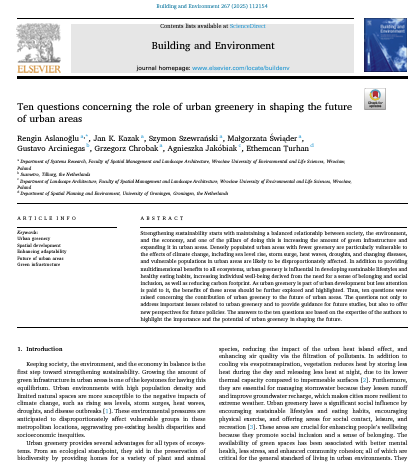
Ten Questions Concerning The Role of Urban Greenery in Shaping The Future of Urban Areas
Keeping society, the environment, and the economy in balance is the first step toward strengthening sustainability. Growing the amount of green infrastructure in urban areas is one of the keystones for having this equilibrium. Urban environments with high population density and limited natural spaces are more susceptible to the negative impacts of climate change, such as rising sea levels, storm surges, heat waves, droughts, and disease outbreaks [1]. These environmental pressures are anticipated to disproportionately affect vulnerable groups in these metropolitan locations, aggravating pre-existing health disparities and socioeconomic inequities.
Urban greenery provides several advantages for all types of ecosystems. From an ecological standpoint, they aid in the preservation of biodiversity by providing homes for a variety of plant and animal species, reducing the impact of the urban heat island effect, and enhancing air quality via the filtration of pollutants. In addition to cooling via evapotranspiration, vegetation reduces heat by storing less heat during the day and releasing less heat at night, due to its lower thermal capacity compared to impermeable surfaces [2]. Furthermore, they are essential for managing stormwater because they lessen runoff and improve groundwater recharge, which makes cities more resilient to extreme weather. Urban greenery have a significant social influence by encouraging sustainable lifestyles and eating habits, encouraging physical exercise, and offering areas for social contact, leisure, and recreation [3]. These areas are crucial for enhancing people’s wellbeing because they promote social inclusion and a sense of belonging. The availability of green spaces has been associated with better mental health, less stress, and enhanced community cohesion; all of which are critical for the general standard of living in urban environments. They also have the potential to provide substantial economic advantages by raising property prices, drawing tourists, and boosting local economies by generating jobs in the upkeep and administration of these environments. Additionally, they save money by lowering energy usage due to their cooling properties and lowering the requirement for expensive stormwater infrastructure.
The incorporation of green spaces into urban settings presents a number of obstacles despite the many advantages. These include the need for interdisciplinary approaches to urban planning that prioritize green infrastructure, conflicting land uses, and financial limitations. Haaland and van Den Bosch [4] argued that there is always a trend towards more residential or commercial development rather than urban green spaces, meaning that parks and natural areas are less accessible. Financial constraints also limit the scope of green infrastructure initiatives and result in insufficient funding for basic maintenance, thus affecting the efficiency and sustainability of these areas [5]. Innovative policies, community involvement, and cross-sector collaboration are needed to address these issues and make sure urban greenery is successfully integrated into urban environments [6]. The study by Sandström and Elander [7] in Örebro, Sweden, demonstrated that well-organized stakeholder involvement and participatory planning can effectively resolve land-use conflicts between construction projects and nature conservation efforts. Therefore, more participatory and collaborative approaches are required.
This paper will explore the various forms of urban greenery, explore the ecological and social benefits they provide, and analyze the challenges and opportunities associated with their integration into the evolving urban landscape by raising ten questions. The answers to these questions are based on the expertise of the authors, underscoring the importance and potential of urban greenery in shaping sustainable, resilient, and livable cities. By emphasizing the ecological, social, and economic benefits of urban greenery, this paper aims to contribute to the growing body of knowledge on sustainable urban development and to inspire action towards creating more green spaces in urban environments.
Throughout this paper several terms will be used such as urban agriculture, urban forests, urban greenery, urban ecosystems, green infrastructure, and nature-based solutions which all contribute to the integration of natural elements within urban environments, but they differ in focus and application [8,9]. Cultivating food in urban environments is called urban agriculture which promotes local food production as well as sustainability. Tree populations found in urban environments regarding air quality, shade provision and biodiversity enhancement are known as urban forests. Urban areas comprising parks, gardens and recreational zones that provide residents with opportunities for relaxation and wellness are known as urban green spaces. All the living organisms within them are part of the urban ecosystem together with their interactions contributing to urban resilience and health. Green infrastructure usually consists of strategically planned out natural or semi-natural areas that manage water, prevent floods, increase urban biodiversity in addition to incorporating green roofs among other elements like permeable pavements and bioswales. Nature-based solutions on the other hand are a wider concept that incorporates using natural processes and ecosystems to solve issues affecting society such as climate change adaptation, disaster risk reduction and human health enhancement. Each of these terms has a shared aim of improving sustainability and resilience by integrating natural elements into urban spaces but they significantly differ regarding their intended objectives; such as food production, diversity of plant species or recreation spaces. However, they all complementary towards making urban places more habitable, sustainable and resilient.
The ten questions selected for the paper are the results of a multi-faceted perspective on urban greenery aiming to discuss in detail the related developments, methods, and challenges in the field. Each question was carefully selected targeting key components of urban greenery and its incorporation into urban planning as well as policy making. Since the selected ten questions present various viewpoints about urban greenery, their answers can be used in future research and decision-making processes. Thus, the paper provides a comprehensive overview of methods for analyzing urban green spaces, their integration into design practices, and global case studies. It concludes by identifying key challenges necessitating further investigation. Specifically, the paper begins by defining urban greenery (Q1) and underscores its significance in ecosystem services and societal well-being (Q2), a crucial foundation for further analysis. Defining urban greenery ensures clarity in scope, as it avoids ambiguities and provide a clear framework for the paper. Addressing the role of greenery in delivering ecosystem services underlines the dual benefits to both ecosystems and people, making it a focal point in discussions about sustainable urban living [10]. Subsequent questions explore how urban green spaces contribute to resilience (Q3) and lower carbon footprints (Q4). These questions are particularly significant as Q3 delves into how urban greenery can serve as natural infrastructure that strengthens urban resilience, an essential component in adapting to the increasing frequency of extreme weather events and Q4 for understanding how urban greenery can align with global carbon reduction goals. Additionally, it investigates the role of urban greenery in spatial development (Q5), methods for assessing their quality and functionality (Q6), and technological advancements enhancing their development (Q7). Those three questions collectively explore how urban greenery not only contributes to environmental goals but also shapes the physical development of cities, highlights the need for robust, standardized methods to assess its success, and demonstrates how emerging technologies can enhance its functionality and adaptability in addressing evolving urban challenges and advancing sustainable development goals. The paper also delves into the costs and benefits of urban greenery in fostering community engagement (Q8) and showcase examples across diverse geographic and socio-political contexts (Q9) to evaluate the balance between the social benefits and financial costs of urban greenery, exploring its potential to foster inclusive and cohesive communities, while examining diverse examples from both developed and developing countries to provide valuable insights into tailoring green spaces to specific urban contexts, identifying best practices, and developing adaptable strategies for varied socio-political and environmental conditions. Finally, it outlines the future research agenda for urban greenery (Q10). Addressing this question ensures the paper contributes to shaping ongoing discourse, proposing new areas of research to enhance the role of urban greenery in building more resilient and sustainable cities.
source :
https://www.sciencedirect.com/science/article/pii/S036013232400996X?via%3Dihub