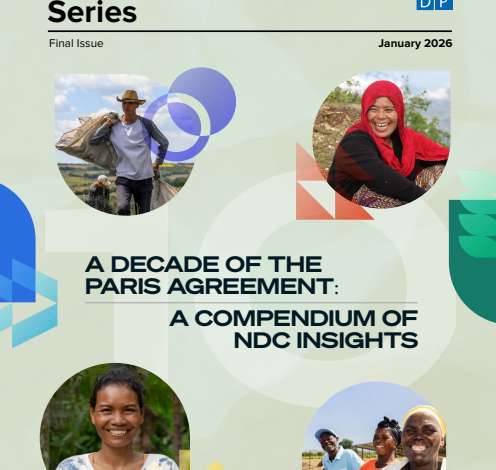
A decade of the Paris agreement a compendium of ndc insights
As countries mark 10 years since the adoption of the Paris Agreement, the third generation of Nationally
Determined Contributions (NDCs) are advancing ambition and showing a decisive shift in quality. New
NDCs incorporate broader sectoral action and outline more rigorous and concrete implementation
pathways. Overall, the new generation of NDCs are reinforcing a commitment for multilateralism and
international cooperation.
By the end of 2025, 128 Parties representing about 78 percent of global greenhouse gas (GHG)
emissions had submitted new NDCs for the 2025 cycle. Of these, 61 countries were supported by the
United Nations (UN) system under the Climate Promise 2025, representing 71 percent of all developing
country submissions. The support from the UN system is evident in many new NDCs. Countries have
strengthened their economy-wide emphasis on climate action, demonstrated country ownership and
social inclusion, included comprehensive co-benefits for economic and social development, and
reflected a higher-level of credibility that encourages investment. Several key trends are emerging.
- Countries are taking concrete steps forward on mitigation ambition and aligning their targets
with their long-term net-zero targets. However, persistent gaps remain in the short- and mediumterm. As the science underscores that a 1.5°C overshoot is inevitable, greater ambition of new NDCs
and more urgent action is critical. At the same time, in light of an expected overshoot, efforts to
enhance adaptation and address loss and damage are equally critical. Many new NDCs, particularly
from developing countries, have prioritized these components with enhanced measures and scope:
90 percent of developing country NDCs enhanced adaptation and 80 percent make explicit
reference to loss and damage. - NDCs are demonstrating concrete progress in highlighting key sectors and emerging themes
that are fundamental to countries’ economies and societies and will help move the needle on
climate action: Notably, all countries include energy, with around 80 percent referencing plans to
reduce the share of fossil fuels in their energy mix, 63 percent including quantified renewable energy
targets and over 50 percent of those with coal in their electricity mix mentioning plans to phase down
unabated coal power. Almost 90 percent include forest-related measures for both mitigation and
adaptation, recognizing forests’ vital role in both curbing GHG emissions and strengthening resilient
livelihoods. Emerging thematic areas such as circular economy (referenced by 84 percent) and
climate, peace and security linkages (70 percent of countries in fragile settings) demonstrate
widening recognition of the interconnected nature of climate and development priorities. - The new climate pledges are more fully embedded in national development priorities and
processes and have stronger coherence with other international frameworks, including the Rio
Conventions and sustainable development goals (SDGs). Countries are increasingly aligning
NDCs with national development and sectoral strategies. At the same time, 95 percent of NDCs
included direct references to the role of nature and biodiversity, aligning with the biodiversity and
land restoration agendas under the Rio Conventions. This coherence strengthens governance,
reduces policy fragmentation and reinforces integrated approaches to tackling climate, nature and
land-related challenges.