
Dokumen
A multi-organization high-level compilation of the most recent science related to climate change, impacts and responses
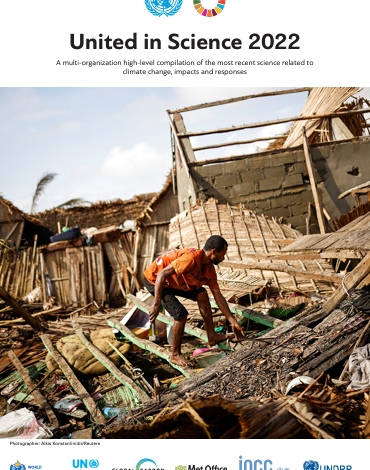
The United in Science report, led by the World Meteorological Organization (WMO) and supported by other prominent organizations, consolidates critical data on the latest climate science, impacts, and responses to climate change. This annual report serves as a unified source of scientific information to help guide decision-makers toward effective climate action.
- Greenhouse Gas (GHG) Concentrations: Despite the COVID-19 pandemic’s brief impact on emissions, atmospheric GHG levels continue to rise, underscoring the need for sustained emissions reductions. The Global Carbon Project observed that CO₂ emissions bounced back to pre-pandemic levels by 2021, showing the deep-rooted challenges in reducing fossil fuel reliance.
- Temperature Increases: The WMO’s State of the Global Climate 2021 report highlighted that 2015-2021 were the seven hottest years recorded, with surface temperatures steadily climbing. Future projections from the Met Office and World Climate Research Programme suggest a 48% chance of reaching a temporary 1.5°C temperature increase above pre-industrial levels within the next five years.
- Emissions Gap: The UN Environment Programme’s Emissions Gap Report reveals that current national pledges fall far short of the ambition needed. To limit warming to 1.5°C, mitigation efforts must be amplified sevenfold, while a fourfold increase is required to keep warming below 2°C. Without such action, achieving the Paris Agreement’s goals will become increasingly elusive.
- Tipping Points and Socioeconomic Impacts: Scientists warn of potential irreversible tipping points in the climate system that could lead to severe, long-lasting consequences. Urban areas, which produce up to 70% of anthropogenic emissions, are particularly vulnerable, as climate impacts will compound existing socioeconomic inequalities, especially among the most vulnerable populations.
- Early Warning Systems: WMO and the UN Office for Disaster Risk Reduction stress the importance of early warning systems in reducing climate risks. These systems are essential for protecting vulnerable populations, yet fewer than half of countries have implemented them, with the lowest coverage in the most at-risk nations. In response, UN Secretary-General António Guterres has called for universal access to early warning systems within five years.
- IPCC Sixth Assessment Reports: The Intergovernmental Panel on Climate Change (IPCC) has recently published comprehensive findings on the physical science, impacts, adaptation, and mitigation of climate change. These reports not only underline the overwhelming scientific consensus on climate risks but also point to areas where further research is needed to refine responses.
United in Science provides a compelling call to action: the science is unequivocal on the need for urgent emissions reductions and adaptation strategies to mitigate the effects of climate change. The UN and its partners continue to work toward providing robust scientific guidance to inform policy and drive global climate solutions.
source :


