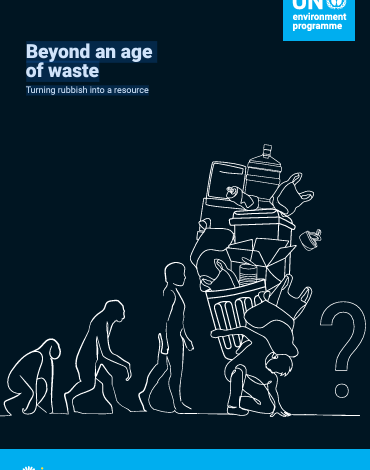
Beyond an Age of Waste Turning Rubbish Into a Resource
Every year across the globe more than two billion tonnes of municipal solid waste (MSW) is generated. If packed into standard shipping containers and placed end-to-end, this waste would wrap around the Earth’s equator 25 times, or further than traveling to the moon and back. As well as municipal waste, human activity generates significant amounts of agricultural; construction and demolition; industrial and commercial; and healthcare waste. This waste is produced on farms and building sites and in factories and hospitals. Municipal waste is generated wherever there are human settlements. It is influenced by each person in the world, with every purchasing decision, through daily practices and in the choices made about managing waste in the home. The way people buy, use and discard materials determines the amount of energy and raw materials used and how much waste is generated. Municipal waste is thus intrinsically linked to the triple planetary crisis of climate change, pollution and biodiversity loss. The first Global Waste Management Outlook (GWMO), published in 2015, provided a pioneering scientific global assessment of the state of waste management. It was also a call to action to the international community to recognise waste and resource management as a significant contributor to sustainable development and climate change mitigation. Since then, despite some concerted efforts, little has changed. If anything, humanity has moved backwards – generating more waste, more pollution and more greenhouse gas (GHG) emissions. Billions of tonnes of municipal waste is still being generated every year, and billions of people still don’t have their waste collected. Uncontrolled waste knows no national borders. It is carried by waterways across and between countries, while emissions from the burning and open dumping of waste are deposited in terrestrial and aquatic ecosystems and in the atmosphere. Pollution from waste is associated with a range of adverse health and environmental effects, many of which will last for generations (Vinti et al. 2021; Siddiqua, Hahladakis and Al-Attiya 2022; World Health Organization WHO 2022). In response to Resolution 2/7, adopted by the second session of the United Nations Environment Assembly and reiterated in Resolution 4/7, adopted by its fourth session (United Nations 2019a), the amount of energy and raw materials used update of the global waste management picture and an analysis of data related to MSW management globally. It assesses three potential scenarios of municipal waste generation and management and their impacts on society, the environment and the global economy. It also provides possible pathways to reducing waste and improving its management—following the waste hierarchy—with the goal that all waste materials are managed as a resource. The Global Waste Management Outlook 2024 echoes the f irst GWMO’s call to action to scale up efforts to prevent waste generation; to extend adequate safe and affordable MSW management to everyone worldwide; and to ensure that all unavoidable waste is managed safely.
source :