Carbon credits market
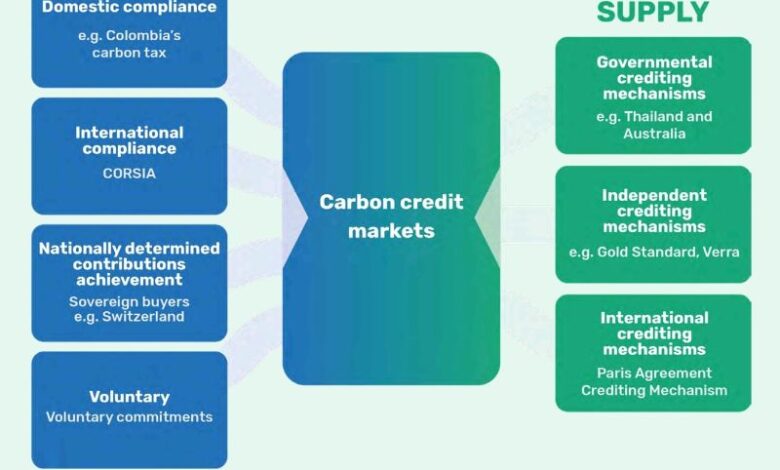
The Carbon Market Engine: Unpacking the Dynamics of Demand and Supply
The global carbon credit market is the financial mechanism driving climate action, but it is far from simple. Operating at the complex intersection of environmental policy, corporate finance, and technological innovation, this market relies on a delicate balance between those who supply verified carbon reductions and those who demand credits to offset their emissions.
Understanding this interplay of demand versus supply, alongside the stringent rules governing credit integrity, is crucial for anyone seeking to build trust, transparency, and genuine impact in the journey toward Net-Zero.
The Demand Side: Who is Buying and Why?
The demand for carbon credits is driven primarily by regulatory requirements and voluntary corporate commitments:
1. Compliance Markets (Mandatory)
These markets are established by governments to meet national or regional emissions reduction goals (e.g., Emissions Trading Schemes or specific taxes).
- Who: Large industrial emitters (power plants, heavy industry), and sometimes transportation sectors, subject to legally binding caps.
- Why: To fulfill regulatory obligations by purchasing allowances or specific carbon credits (often with required adjustments) to cover their unavoidable emissions. This is non-negotiable legal compliance.
2. Voluntary Markets (Corporate Action)
These markets are driven by corporate targets and stakeholder pressure, operating outside of legal mandates.
- Who: Companies pursuing Net-Zero or Carbon Neutrality pledges, often driven by ESG targets, investor pressure, and consumer expectations.
- Why: To compensate for hard-to-abate Scope 1, 2, and 3 emissions through offsetting, and to fund climate projects that cannot be realized otherwise. This is a strategic business and reputation decision.
The Supply Side: Where Do the Credits Come From?
The supply side consists of diverse projects that achieve measurable reductions or removals of greenhouse gases:
1. Nature-Based Solutions (NBS)
These projects leverage the power of natural ecosystems to absorb carbon.
- Examples: Reforestation and afforestation, avoided deforestation (REDD+), regenerative agriculture, and coastal ecosystem restoration (Blue Carbon).
- Challenge: Ensuring permanence (credits are not reversed by fire, disease, or re-clearing) and accurately measuring the carbon stored.
2. Technology-Based Solutions
These projects involve engineering solutions for emissions reduction or removal.
- Examples: Renewable energy installations (solar, wind), energy efficiency improvements, carbon capture and storage (CCS), and Direct Air Capture (DAC).
- Advantage: Often offer higher permanence and clearer quantification, especially for removal technologies like DAC, which is growing in importance.
The Integrity Challenge: Trust, Transparency, and Double Counting
The market’s complexity stems from the critical need for integrity:
- Non-Interchangeable Credits: Not all credits are created equal. They differ based on their vintage (year of creation), project type (reduction vs. removal), and co-benefits (social impact, biodiversity). Buyers must ensure the credits are material to their climate claim.
- Avoiding Double Counting: A strict regime is necessary to prevent the same emission reduction from being claimed by both the credit supplier (the host country or project developer) and the credit buyer (the corporation). International compliance often requires complex Corresponding Adjustments (CAs) to authorize the credit transfer, a rule set under Article 6 of the Paris Agreement.
- Building Trust: The future growth of the market depends entirely on the transparency and robustness of the verification bodies (e.g., Verra, Gold Standard) and their ability to ensure additionality (the project would not have happened without the revenue from the carbon credit).
Ultimately, the functioning of the carbon market is a balancing act: translating the physical reality of emissions reduction (supply) into a verified, tradeable asset (demand) that drives global capital towards impactful climate solutions.
source: