Circular Sustainability
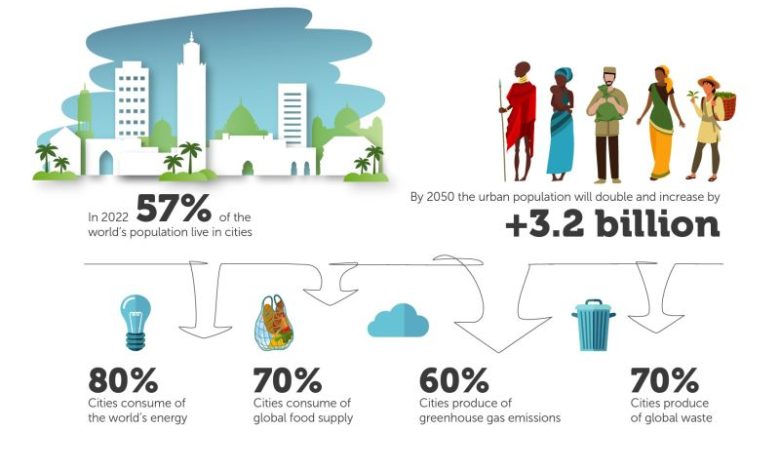
The world is in the midst of an urban revolution cities are no longer just places where people live and work; they are the heartbeat of our planet’s future. With 57% of the global population already residing in urban areas and an anticipated 3.2 billion more people making cities their home by 2050, the way we shape urban environments today will determine the trajectory of sustainability for generations to come.
But here’s the challenge:
🔹 Cities consume 80% of the world’s energy
🔹 They generate 70% of global waste
🔹 They demand 70% of the global food supply
🔹 They contribute 60% of greenhouse gas emissions
Clearly, cities are at the center of both the problem and the solution. The way forward is not about merely sustaining urban life it’s about reimagining it. Cities must evolve into dynamic ecosystems that embrace innovation, resilience, and circularity.
Urban Renaissance: Five Transformative Pathways
1. Circular Cities: The End of Waste
Imagine a city where waste is no longer an issue because every byproduct has a second life. A circular urban system eliminates the “take-make-dispose” mindset, instead fostering regenerative cycles where materials, energy, and resources are continually repurposed. From bio-based packaging to waste-to-energy systems, circularity is the blueprint for a zero-waste future.
2. Green Mobility: Moving Beyond Pollution
Cities are suffocating under the weight of traffic congestion and vehicle emissions. The solution? A revolution in mobility one that prioritizes electric vehicles, bike-friendly streets, seamless public transport, and pedestrian-first planning. Smart mobility isn’t just about reducing emissions; it’s about designing cities for people, not just cars.
3. Smart Urban Planning: Cities That Think
Technology is changing how cities function. With AI, IoT, and big data, urban environments can become more responsive, efficient, and adaptive. Smart grids, real-time traffic monitoring, and AI-powered resource allocation can turn chaotic urban sprawl into harmonized, high-performing hubs of sustainability.
4. Urban Agriculture: Farms in the Sky
What if your next meal came from a vertical farm in the heart of the city? Rooftop gardens, hydroponic towers, and community farming initiatives bring food production closer to urban residents, cutting down food miles, enhancing food security, and reconnecting people with nature. Green cities grow what they eat right where they live.
5. Holistic Well-being: Cities That Nurture
A truly sustainable city isn’t just about reducing emissions it’s about enhancing quality of life. Parks, urban forests, and green corridors are more than pretty landscapes; they clean the air, lower temperatures, and boost mental health. Walkable streets, public spaces, and accessible healthcare create cities that prioritize people’s well-being as much as their infrastructure.
Cities: The Catalysts for Change
The path to sustainability is not a distant utopia it is being paved right now, in the decisions we make about our urban spaces. Cities are not just where the majority of the world lives; they are the incubators of human progress. By rethinking waste, mobility, food, and well-being, we can transform our urban environments into beacons of sustainability, pioneering a world where people and the planet thrive together.
source :