
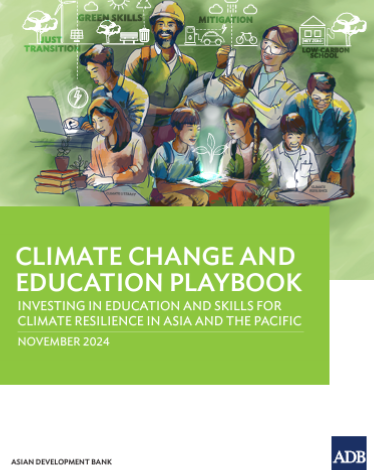
Climate change and education playbook | investing in education and skills for climate resilience in asia and the pacific
Climate change and the transition to a low-carbon and climate-resilient economy are key policy challenges in Asia and Pacific. Among all regions in the world, Asia and the Pacific has the largest exposure to climate change and has incurred the greatest economic losses between 1980–2022 caused by disasters triggered by natural hazards (Dabla-Norris et al. 2023). Nine out of 15 nations most affected by extreme weather are in Asia and the Pacific (IFHV 2023). With the region falling short of its climate targets, extreme weather events are expected to intensify, leading to economic harm and hindering socioeconomic progress (ADB 2024a; ADB 2024d). At the same time, the region is increasingly a contributor to the global climate crisis with its share of global greenhouse gas (GHG) emissions doubling from 22% in 1990 to over 50% in 2024 (ADB 2023, ADB 2024b). Consequently, transitioning to a low-carbon and climateresilient economy and society is urgently needed to meet climate targets and prevent a global crisis driven by disasters, weather extremes, food and water insecurity, and economic disruption. Like all sectors, the education sector is exposed to the risks and opportunities of climate change and requires strategic rethinking (Reimers 2021). Education systems need to adapt to climate risks becoming climate-resilient and provide learners, including youth, workers, and communities with the competencies and skills needed to live and work in low-carbon and climate-resilient economies and societies. Climate change exacerbates the learning crisis. Extreme weather events, such as extreme heat, floods, and storms, negatively affect learning outcomes. Schools increasingly face weather-related disruptions to educational services, with school closures being a key cause of learning losses (Saavedra and SherburneBenz 2022). Extreme heat and other calamities caused 32 days of school closures in the Philippines in the school year 2023–2024, disrupting learning continuity (PIDS 2024). It has been shown that students who experience prolonged exposure to storms are more likely to experience educational delays, are less likely to complete higher education, and are less likely to secure salaried employment (Pelli and Tschopp 2024). In Pakistan, the floods of 2022 damaged or destroyed at least 17,205 schools, disrupting the education of approximately 2.6 million children (Ministry of Planning Development & Special Initiatives 2022). Making education facilities and operations climate resilient is a growing policy priority in the education sector to prevent learning losses, physical harm to learners and teachers, and damage to school assets that prolong school closures. At the same time, school facilities and operations can lower their own environmental impact to mitigate climate impacts through resource-efficient school facility designs and management.
source :
https://www.adb.org/publications/climate-change-education-playbook


