Climate Change as an Environmental Problem
99% of professionals see climate change as an environmental problem❗🤷♂️But its real impact goes far beyond rising temperatures.
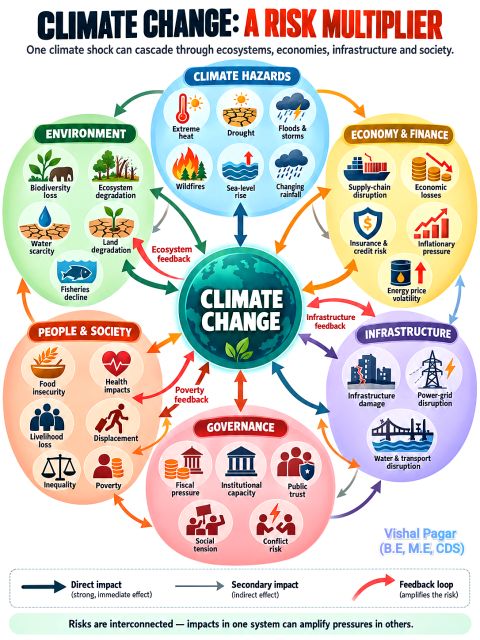
Climate change is a risk multiplier.
A single climate shock can trigger a chain reaction across ecosystems, economies, infrastructure, public health, and governance.
The real danger is not just the initial event. It is how one disruption creates pressure across multiple interconnected systems.
Here’s how the domino effect works:
– Environment: Extreme heat, droughts, floods, and wildfires accelerate biodiversity loss, ecosystem degradation, water scarcity, and fisheries decline.
– Economy and finance: Climate disruptions affect supply chains, increase insurance and credit risks, drive energy price volatility, and create inflationary pressure.
– Infrastructure: Flooding and extreme weather damage buildings, disrupt power grids, and threaten water and transportation networks.
– People and society: Food insecurity, health impacts, livelihood losses, and displacement can deepen poverty and inequality.
– Governance: Climate-related crises increase fiscal pressure, challenge institutional capacity, weaken public trust, and raise the risk of social tension and conflict.
The most critical part? Feedback loops.
When ecosystems degrade, communities lose livelihoods. When poverty increases, recovery becomes harder. When infrastructure fails, economic losses rise. And when public institutions are under pressure, managing the next climate shock becomes even more difficult.
Each impact can amplify the next.
This is why climate risk cannot be assessed in isolation.
For businesses, sustainability professionals, and policymakers, the practical takeaway is clear:
– Assess climate risks across the entire value chain, not just direct operations.
– Identify dependencies between ecosystems, resources, suppliers, infrastructure, and communities.
– Evaluate both physical climate risks and their financial consequences.
– Use life cycle assessment (LCA) to understand environmental impacts across a product’s life cycle, while recognizing that climate risk assessment addresses broader systemic vulnerabilities.
– Build resilience strategies that address interconnected risks rather than isolated symptoms.
Climate resilience starts with understanding the connections.
The organizations that prepare for tomorrow’s climate risks will be those that recognize how environmental, social, and economic pressures interact today.