
Tahukah Anda
Natural living ideas
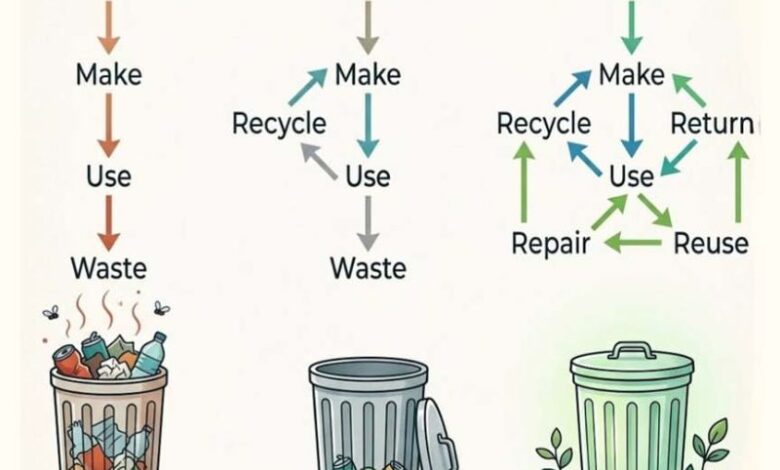
The traditional industrial model relies on an unsustainable throughput curve: Take ~> Make ~> Use ~> Waste. While recycling mitigates end-of-life disposal, it operates as a downcycling mechanism that loses material structural integrity over time.
A true circular economy shifts the focus upstream from waste management to waste elimination through design.
Strategic Pillars of Closed-Loop Design
1. Upstream Design for Longevity & Modular Repair
- Disassembly Architecture: Designing products with standard fasteners rather than chemical adhesives enables individual component replacement (e.g., modular electronics).
- Material Standardization: Reducing composite polymers and mixed-material bonding streamlines secondary raw material recovery without downcycling.
2. Serviceization & Product-as-a-Service (PaaS)
- Ownership vs. Access: Shifting business models from selling physical hardware to leasing performance guarantees (e.g., lighting-as-a-service, vehicle fleets).
- Incentivized Durability: When manufacturers retain product ownership, financial incentives align toward engineering maximum durability rather than planned obsolescence.
3. Cascading Reuse & Industrial Symbiosis
- Industrial Ecology: Establishing closed-loop networks where output waste or thermal byproduct from one industrial process becomes direct input feed for an adjacent facility.
- Secondary Life Conversion: Repurposing high-value components before raw material breakdown (e.g., re-manufacturing EV batteries into stationary grid storage).
Linear vs. Circular Economic Models
| Metric / Dimension | Linear Economy (Take-Make-Waste) | Recycling Economy (Downcycling) | Circular Economy (Closed-Loop) |
| Primary Objective | Maximize throughput volume | Divert end-of-life landfill waste | Eliminate waste by design |
| Value Retention | Lost post-consumption | Partial loss through material degrade | High value maintained via reuse & repair |
| Supply Chain Risk | High exposure to raw material price shocks | Moderate dependency on virgin inputs | High resilience via reclaimed material loops |
| Business Model | One-off transactional sale | Post-consumer recycling compliance | Product-as-a-Service (PaaS) & leasing |
Re-architecting products for endless lifecycle loops changes waste from a disposal liability into a permanent, recoverable asset.
source:


