
Climate change the great displacer
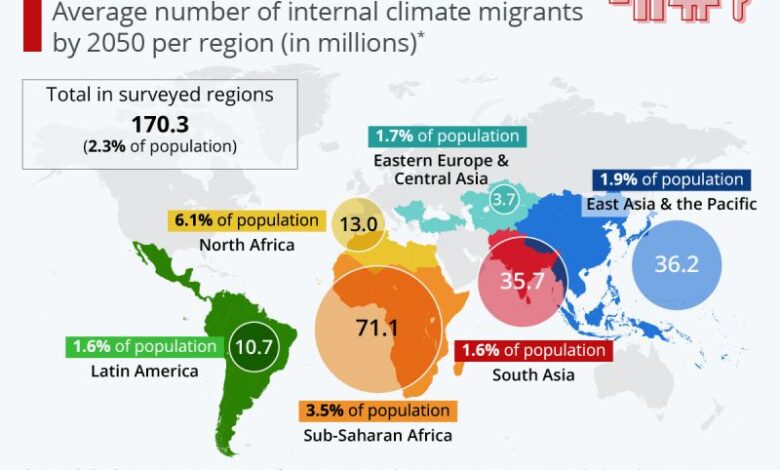
The Great Displacer: 170 Million Lives In Motion by 2050
Forget borders, economics, or conventional conflict the single most powerful, silent force redrawing the human map this century is climate instability. We stand at the precipice of the largest forced internal migration in history, a crisis set to put 170 million lives on the move within their own national boundaries by 2050.
This is not a slow trickle. This is a demographic and humanitarian tidal wave driven by the collapse of livability. As water vanishes, agricultural land turns to dust, and rising seas engulf coastal homes, entire communities will be stripped of their stability and their fundamental right to a home in a single, brutal generation.
The Anatomy of Displacement: Where the Crisis Hits Hardest
The pressure is tragically uneven, striking the most vulnerable regions with relentless intensity, according to high-emission and unequal-development projections:
- Sub-Saharan Africa: The epicenter of the crisis, facing the displacement of 71 million people.
- East Asia & the Pacific: Confronting the movement of 36 million.
- South Asia: Preparing for the uprooting of 35 million.
- Latin America: Managing an exodus of 10.7 million.
- North Africa: Facing the highest share of its population affected (6.1%), a sign of systemic regional vulnerability.
Beyond Borders: The Systemic Shock
Climate migration is far more than a statistic on a relocation form. It is a profound systemic shock that will fundamentally destabilize national planning:
- The Urban Shock: Major cities, already straining under density, will be forced to absorb sudden, massive population surges. This instantly overwhelms housing, sanitation, and healthcare systems, escalating social tension and inequality.
- The Rural Collapse: Productive agricultural regions will empty out faster than they can adapt, leading to accelerated decline, the destruction of local economies, and intensified pressure on national food security.
- The Governance Test: This crisis will redefine labor markets, strain national budgets, and test the limits of governance. The ability of nations to maintain stability, provide services, and protect human rights will hinge entirely on their capacity to manage this forced mobility.
The Mandate for Action
This projected displacement of 170 million people is not an inevitability it is a catastrophic scenario that we still have the power to mitigate. To contain this crisis, adaptation, resilience, and equitable development must stop being tertiary goals and become the absolute core of global geopolitical strategy. We must invest today in stabilizing the communities of tomorrow, making their current homes resilient enough to withstand the forces we have unleashed. The choice is stark: Invest radically in resilience now, or be consumed by the humanitarian cost later.


