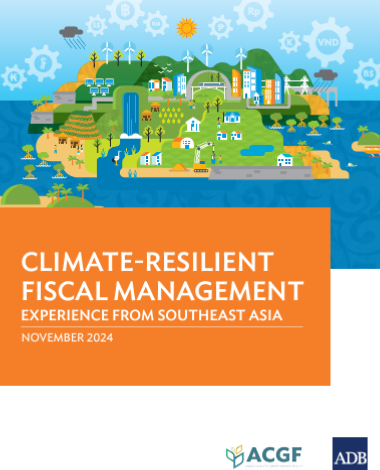
Climate resilient fiscal management
Physical risks associated with climate change are already affecting Southeast Asian countries and are set to increase rapidly. Acute physical risks, such as floods, heat waves, tropical cyclones, and droughts, already cause annual losses of $5.2 billion in the region, with extreme events causing losses as great as 10%–45% of gross domestic product (GDP) in highly exposed countries such as Cambodia, Myanmar,1
the Philippines, Thailand, and Viet Nam.
There are also chronic risks, such as sea level rise, which affect Southeast Asian countries, given the concentration of population and development in low-lying plains, coastal river deltas, and coastal areas. Regardless of global efforts to reduce emissions, these risks will grow rapidly until 2030 and beyond, threatening lives, livelihoods, and broader development objectives.
The climate transition, while limiting physical risk over the long term, may also lead to significant frictions,
as economies shift away from carbon-intensive products, processes, and technologies. Transition risks range from policy and regulatory risks, which can raise costs for high emissions sectors, to technology and market risks such as changing consumer trends and uptake of new technologies. Pressures on Southeast Asian countries from the transition will be substantial, with fossil fuels constituting about 80% of the region’s energy mix and renewable alternatives underdeveloped.
Additional pressures will be felt by fossil-fuel-producing countries in Southeast Asia: for instance, the petrochemical industry accounts for 11% of Malaysia’s export and the national petrochemical producer accounted for 15% of the Malaysian government’s revenues between 2015–2020. Southeast Asian
countries are also particularly exposed to global trends in decarbonization, with high levels of export dependency.
Finance and planning ministries have a critical role in responding to climate-related risks and opportunities. These ministries, responsible for government financial functions, including budget and investment management, tax and subsidy policy, debt management and financing, monitoring of public entities, and financial system regulation (Figure 1), are referred to as central finance agencies (CFAs) in this report. These core functions of CFAs are affected by trends and shocks caused by both physical and transition risks. At the same time, CFAs play a critical role in developing a fiscal system that helps accelerate the net-zero transition, thereby containing future climate change, and that promotes resilience to physical risk.
source :
https://www.adb.org/publications/climate-resilient-fiscal-management-southeast-asia