Finland develops wireless electricity system where power moves freely through air without cables
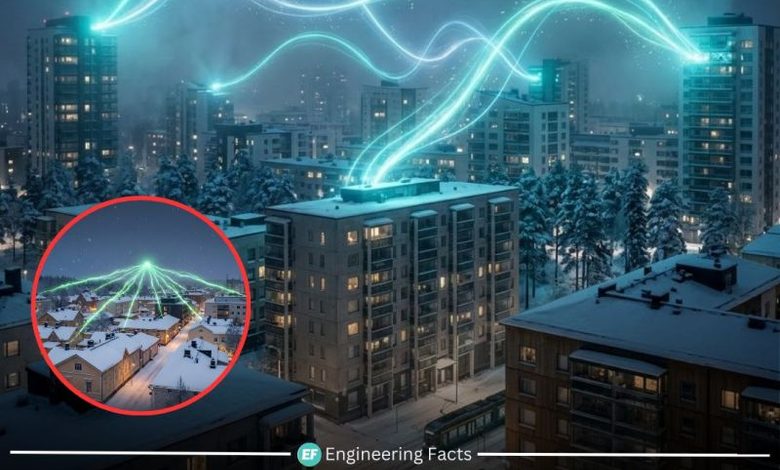
When Electricity Starts Moving Without Cables
Imagine a robot operating continuously without cables restricting its movement. Or an industrial device that can receive power while moving, rotating, or changing position—without being physically connected to a power source.
This idea is no longer purely futuristic. In Finland, researchers and startups are exploring wireless power transfer, a technology that allows electrical energy to move from a source to a device without a physical cable.
The technology uses principles such as electromagnetic fields and resonant coupling to transfer energy across a certain distance. Instead of electricity flowing through a wire, energy is transferred through a field connecting the power source and the receiving device.
From Charging to Continuous Power
Wireless charging is already familiar through smartphones, smartwatches, and other consumer electronics. But developments in Finland point toward much broader possibilities.
Cable-free robots
Industrial robots could move more freely without cables that can become tangled, caught, or restrictive.
More flexible industrial systems
Moving machines and components could receive power without a direct physical connection, opening new possibilities for more dynamic production environments.
Smart infrastructure
Future buildings and public spaces could potentially integrate wireless power systems directly into their infrastructure.
Power for moving devices
Devices that rotate, move, or change position could potentially receive energy without having to remain physically plugged in.
Startups such as Willo are also exploring applications for this technology, pushing wireless power beyond simple charging toward the concept of continuous energy delivery.
But There Is an Important Reality Check
Despite its futuristic appeal, wireless power is still an emerging technology.
Wireless electricity does not mean that large amounts of electricity can simply be transmitted over long distances without energy losses. Transfer distance, efficiency, power capacity, safety, infrastructure costs, and device compatibility remain important challenges.
In other words, we are not yet at a stage where homes or electricity grids can receive large-scale power from distant sources without cables.
But that is precisely what makes the technology so fascinating.
The Future of Energy Is Not Only About Generating Electricity
The energy transition is often discussed in terms of how electricity is generated—through solar, wind, hydropower, biomass, and other renewable sources.
But another question is equally important:
How can we deliver, access, and use that energy more intelligently and efficiently?
Wireless power could help create energy systems that are not only cleaner, but also more flexible, adaptive, and integrated with technology.
Imagine factories where cables no longer restrict the movement of robots. Cities where infrastructure can provide energy automatically. Or devices that no longer depend entirely on traditional power outlets because energy is available when and where it is needed.
Perhaps the future of energy is not about eliminating cables altogether.
It is about making access to energy smarter.
From renewable generation to wireless power, the way we produce, distribute, and use energy is being reimagined.
Because the energy revolution does not end when electricity is generated. The next revolution is about making electricity work smarter.
source: