Finland has achieved transmitting electricity by the air without cable
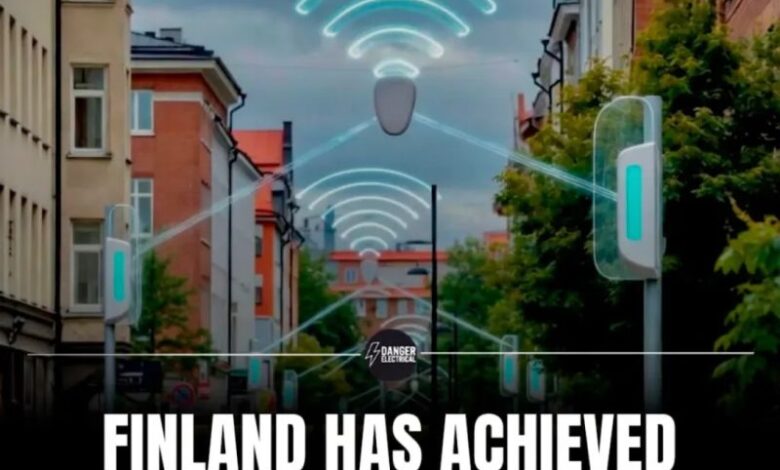
The End of Copper: Unpacking Finland’s Wireless Energy Breakthrough
Finland’s successful transmission of electricity through air unplugged and untethered marks the shift from Inductive Charging (which requires physical contact, like smartphone pads) to Ambient Wireless Power Transfer (WPT). By utilizing low-frequency radio waves, this technology treats electricity much like a Wi-Fi signal, creating “power zones” where devices charge simply by existing within the space.
1. The Science: How Radio Frequency (RF) Becomes Power
The system operates on the principle of Electromagnetic Radiation (EMR) at specific low frequencies that are safe for human exposure.
- The Transmitter: Converts electricity from the grid into a specific radio frequency waveform.
- The Beam: Uses “Beamforming” technology (similar to 5G) to direct energy specifically toward a device’s location, minimizing energy “spill” or waste.
- The Rectenna: The receiving device is equipped with a Rectifying Antenna (Rectenna). This component captures the RF waves and converts them back into Direct Current (DC) electricity to power the device or charge its battery.
2. Technical Specs & Current Limitations
To understand the viability of this breakthrough, we must look at the current engineering constraints:
| Metric | Current Status (Experimental) | Future Target (Scaling) |
| Power Output | Low (milliwatts to a few watts) | High (powering laptops/TVs) |
| Distance | Short (within a room/3-5 meters) | Mid-range (across an office floor) |
| Efficiency | Moderate (loss occurs over distance) | High (optimized beamforming) |
| Frequency | Low-frequency RF (Safe) | Optimized resonant coupling |
3. Strategic Impact: The “Battery-Free” World
This innovation isn’t just about convenience; it is a fundamental shift in Sustainable Product Lifecycle Management.
- The Death of the AA Battery: Most IoT (Internet of Things) devices fail because their batteries die. Wireless power allows for millions of sensors in “Smart Cities” to run indefinitely without human maintenance.
- Decarbonizing Construction: Traditional buildings require miles of copper wiring behind walls. Wireless power could reduce copper demand in internal building fit-outs by up to 40%, significantly lowering the “embodied carbon” of new architecture.
- E-Waste Mitigation: With the elimination of proprietary charging cables and disposable batteries, we tackle the fastest-growing waste stream on the planet.
4. The Transition Path: Infrastructure vs. Consumer
The integration of this technology will likely follow a three-stage rollout:
- Industrial IoT (2026-2027): Powering factory sensors and warehouse tracking tags that are currently hard to reach or wire.
- Commercial Spaces (2028-2030): Offices and airports providing “Power Wi-Fi” zones for keyboards, mice, and low-power peripherals.
- The Invisible Home (2030+): Total integration where lights, smart speakers, and small kitchen appliances draw power from a central hub hidden in the ceiling.
Final Perspective: Energy as a Utility “Atmosphere”
Finland has moved energy from being a tethered commodity to an atmospheric utility. Just as we no longer think about “plugging in” to the internet because of Wi-Fi, we are approaching an era where we will no longer think about “plugging in” to the grid. The air around us is becoming the new conductor.
source: