From a Linear Economy to a Circular Economy
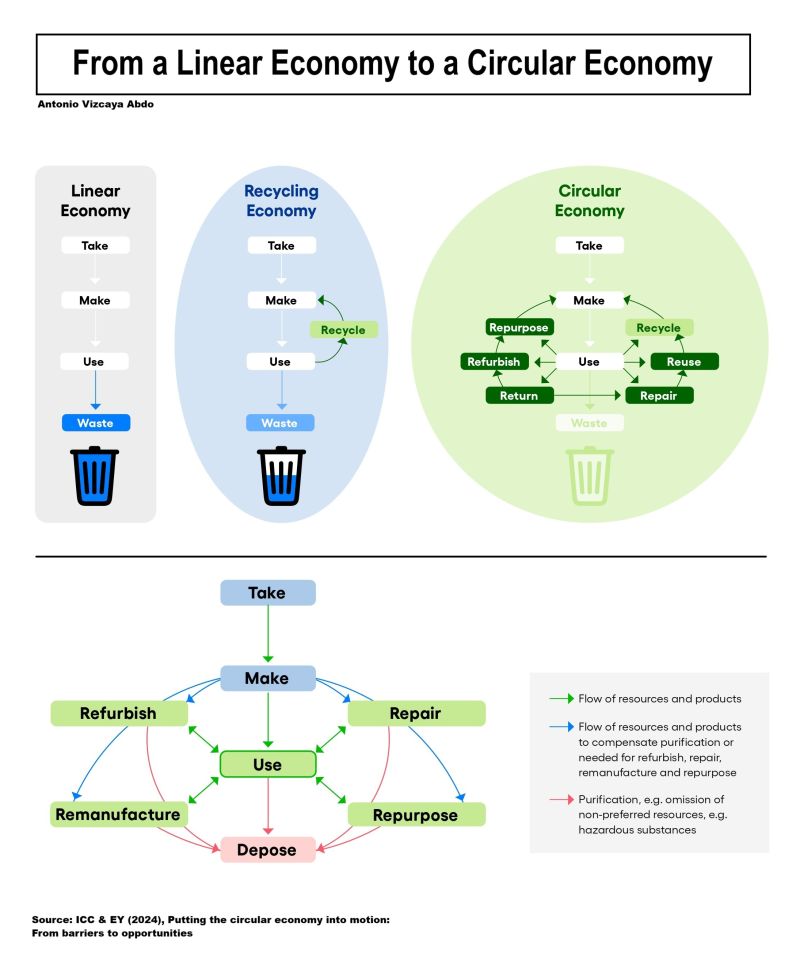
The circular economy is not an extension of current systems. It replaces them. It moves from value extraction to value retention, shifting focus from volume to performance, from throughput to durability.
Recycling addresses part of the problem but operates within a system that still tolerates waste. In a circular economy, waste is treated as a design failure. The goal is not to manage waste more efficiently but to prevent it from being created in the first place.
This requires decisions to be made at the design phase. Materials must be selected for reuse, recovery, and safe reintegration. Products must be built for disassembly, for upgrade, for second and third life applications. This has implications across procurement, product development, and compliance.
For companies, this transition affects the full lifecycle. It requires building systems where products can be returned, repaired, and reintroduced into the market. Reverse logistics, service-based models, and material traceability become part of the core business process.
This also means decoupling growth from resource use. A circular model challenges the idea that increased sales must depend on increased extraction. Instead, it prioritizes value over volume, resilience over speed, and regeneration over depletion.
Operational complexity increases. To close loops, companies must manage longer product lifecycles, coordinate across actors, and integrate new data systems. Material flow mapping, lifecycle analysis, and durability standards become operational requirements.
The financial logic changes. Capital allocation must factor in lifecycle value, embedded risk, and regulatory exposure. Metrics move beyond cost and margin to include resource productivity, avoided loss, and total system efficiency.
From a regulatory standpoint, this shift is accelerating. Taxonomies, extended producer responsibility laws, and product take back schemes are becoming central in many markets. Being ahead of these shifts allows businesses to shape rather than react to policy.
Innovation plays a central role. From bio-based materials to digital product passports, from modular design to AI-driven reuse platforms, circular models open pathways for new capabilities and competitive positioning.
Brand differentiation also evolves. Circularity is not framed as an environmental commitment but as a design, quality, and service proposition. Businesses that lead in circular practices will be judged not by their claims but by the functionality, traceability, and performance of their products.
Transitioning to a circular economy is not about improving an old model. It is about building a new one, designed for efficiency, for continuity, and for a resource-constrained future.
The challenge is structural. The opportunity is systemic.
Source: