Greenhouse gas emissions by sector
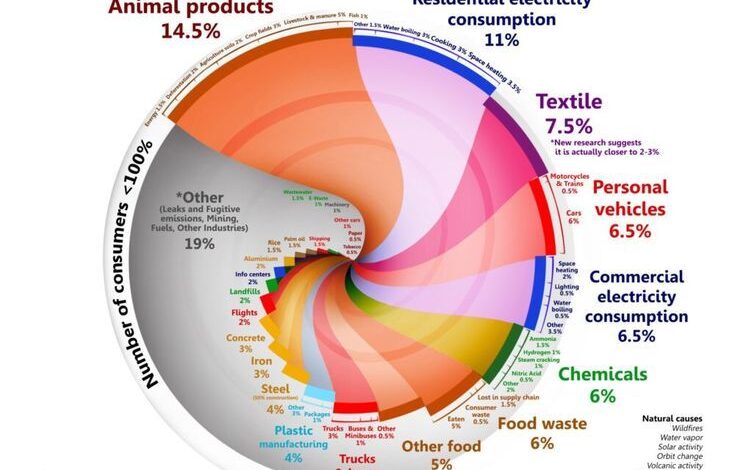
The Consumption Crisis: A Sector Breakdown
Global emissions are the “shadow” of our global economy. Understanding the percentages helps us prioritize where our efforts will yield the highest return.
| Sector | Contribution | The Hidden Driver |
| Animal Products | 14.5% | Livestock farming produces massive amounts of methane ($CH_4$), which is 80 times more potent than $CO_2$ over a 20-year period. |
| Residential Electricity | 11.0% | The cooling, heating, and lighting of billions of homes globally, still largely powered by fossil fuels. |
| Textiles & Fashion | 7.5% | The “Fast Fashion” cycle—energy-intensive synthetic fibers, global shipping, and massive landfill waste. |
| Personal Vehicles | 6.5% | While highly visible, individual transport contributes less than the food we eat or the homes we inhabit. |
| Food Waste | 6.0% | If food waste were a country, it would be the third-largest emitter in the world. |
| Chemical Production | 6.0% | The unseen backbone of modern life, from plastics to fertilizers. |
| Other Industries | 19.0% | Mining, fuel extraction, and industrial leaks (fugitive emissions). |
The “Systems Thinking” Insight
Climate change is not a “tailpipe problem”—it is a systemic failure. It is the cumulative result of how we produce, what we consume, and how we value resources. We cannot solve the crisis by fixing one sector; we must redesign the entire loop of consumption.
Strategic Action Pathways: From Awareness to Impact
To move the needle in 2026 and beyond, action must occur at three levels: Individual, Corporate, and Policy.
1. The Plate: Plant-Forward Transition
Shifting toward plant-based diets is the single most effective “lifestyle lever” to reduce personal carbon footprints.
- Action: Reduce beef and lamb consumption to significantly lower methane output.
2. The Home: Efficiency & Electrification
Household energy use is a sleeping giant in the emissions data.
- Action: Transition to heat pumps, LED lighting, and solar-integrated smart grids to decouple living standards from carbon.
3. The Closet: Moving Beyond Fast Fashion
We must transition from a “disposable” culture to a circular economy.
- Action: Support brands that offer lifetime warranties and use recycled textiles; resist the urge of ultra-fast-fashion trends.
4. The Policy: Industrial Decarbonization
Governments must mandate transparency in chemical and mining sectors, which often operate in the shadows.
- Action: Support carbon pricing and subsidies for “green hydrogen” in heavy industry.
The Power of Collective Compounding
A 1% change in global food waste or textile production is more impactful than taking millions of cars off the road. When we shift our focus to these high-leverage sectors, small individual choices compound into massive global progress.
source: