How are climate change, biodiversity loss and pollution connected?
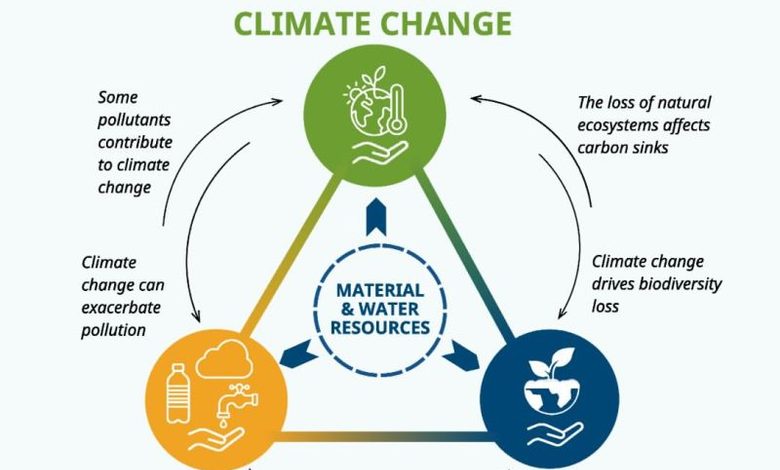
Climate change. Biodiversity loss. Pollution.
For years, these three challenges have often been treated as separate environmental problems, each with its own policies, experts, targets, and solutions.
But nature does not work in silos.
A forest does not know where climate policy ends and biodiversity policy begins. A river does not distinguish between plastic pollution, chemical contamination, and rising temperatures. A farmer experiencing drought, soil degradation, declining pollinators, and unpredictable weather does not experience them as four different crises.
They are part of the same system.
This is why the world increasingly refers to them as the Triple Planetary Crisis: climate change, biodiversity loss, and pollution.
At the heart of this crisis lies a deeper question:
How are we producing, consuming, and using the natural resources that sustain our economies and our lives?
Understanding this connection is essential because solving one crisis while worsening another can simply move the problem from one part of the planet to another.
1. Climate Change Is Not Only About Temperature
When we talk about climate change, the conversation often focuses on rising temperatures, extreme weather, melting ice, sea-level rise, and greenhouse-gas emissions.
But climate change is also a biodiversity crisis.
As temperatures rise and rainfall patterns shift, ecosystems are pushed beyond the conditions in which many species evolved.
Coral reefs experience increasingly severe marine heatwaves and coral bleaching. Forests face greater risks from drought, wildfire, pests, and ecosystem disruption. Mountain species can lose suitable habitat as climate zones shift upward.
For many species, the problem is not simply that the planet is becoming warmer.
The problem is that their homes are changing faster than they can adapt.
Climate change can also amplify the damage caused by pollution and ecosystem degradation.
For example, a polluted river may already be under ecological stress. Add higher temperatures, reduced water flows, or extreme rainfall, and the ecosystem’s ability to recover can become even weaker.
Climate change therefore acts not only as a crisis by itself, but also as a multiplier of existing environmental pressures.
2. Biodiversity Is More Than a List of Species
Biodiversity is sometimes reduced to the number of animals and plants living on Earth.
But biodiversity is much more than that.
It includes the variety of species, genetic diversity, and the ecosystems in which life interacts.
And those ecosystems provide services that human societies depend on every day.
Forests store carbon.
Wetlands regulate water.
Mangroves protect coastlines.
Pollinators support agriculture.
Healthy soils support food production.
Oceans regulate climate and provide livelihoods.
When biodiversity declines, we are not simply losing species.
We are weakening the natural infrastructure that supports human civilization.
A degraded forest, for instance, may store less carbon, regulate water less effectively, support fewer species, and become more vulnerable to fires and invasive species.
This creates a dangerous feedback loop:
Climate change damages ecosystems → degraded ecosystems lose their ability to absorb carbon → atmospheric greenhouse gases increase → climate change becomes more severe.
Protecting biodiversity is therefore not separate from climate action.
Nature is part of the climate solution.
3. Pollution Turns Environmental Stress into a Systemic Problem
Pollution is the third part of the equation.
Plastic waste, toxic chemicals, air pollution, wastewater, agricultural runoff, and other forms of contamination can damage ecosystems and directly threaten biodiversity.
A polluted river can become unsuitable for fish and aquatic plants.
Excess nutrients can trigger algal blooms and reduce oxygen levels in water.
Toxic substances can accumulate through food chains.
Plastic pollution can injure or kill marine animals.
Air pollution can damage forests, crops, and human health.
But pollution is also connected to climate change.
Many pollutants are generated throughout the same economic systems responsible for greenhouse-gas emissions: extraction, manufacturing, transportation, agriculture, energy production, and waste management.
Some activities can therefore produce multiple environmental impacts simultaneously.
A fossil-fuel-intensive industrial process, for example, may contribute to greenhouse-gas emissions while also generating air pollution and waste.
This is why addressing pollution cannot simply mean cleaning up the consequences.
We need to examine the production and consumption systems that create pollution in the first place.
4. The Hidden Connection: Resource Use
If climate change, biodiversity loss, and pollution are the visible symptoms, resource use is one of the deeper drivers connecting them.
Every product begins somewhere.
A phone requires minerals.
A building requires sand, stone, metals, and energy.
Food requires land, water, fertilizer, transportation, and packaging.
Clothing requires fibers, water, chemicals, and energy.
Plastic requires fossil-fuel feedstocks.
Electricity requires infrastructure and, depending on the energy source, various natural resources.
The challenge is not that humans use resources.
We always will.
The challenge is how much we use, how efficiently we use them, where they come from, and what happens to them after use.
When resource extraction expands without adequate environmental safeguards, forests can be cleared, habitats fragmented, rivers polluted, and communities displaced.
When production is energy-intensive, greenhouse-gas emissions can increase.
When products are designed for short lifespans and discarded quickly, waste increases and more resources must be extracted to replace them.
This creates a chain reaction:
Extraction → Production → Consumption → Waste
At every stage, pressure can be placed on climate, biodiversity, and ecosystems.
5. One Crisis Can Reinforce Another
The relationship is not simply three separate arrows pointing in different directions.
It is a feedback system.
Consider a forest.
When a forest is cleared, biodiversity declines.
At the same time, carbon stored in vegetation and soils can be released into the atmosphere.
The loss of forest cover can also affect water cycles, soil stability, and local climate conditions.
If the land is subsequently degraded, it may become more vulnerable to erosion and pollution.
The resulting environmental changes can then make surrounding ecosystems less resilient to climate impacts.
The same pattern can occur in coastal ecosystems.
Destroying mangroves means losing habitat for species, reducing natural coastal protection, weakening carbon storage, and potentially increasing vulnerability to storms and sea-level rise.
This demonstrates a crucial principle:
Environmental systems are interconnected because nature itself is interconnected.
6. Why Solving the Crises Separately Can Backfire
Imagine a country rapidly expanding renewable energy to reduce greenhouse-gas emissions.
That is important.
But if the transition requires minerals extracted with inadequate environmental safeguards, the result could create new pressures on forests, water systems, and biodiversity.
Or consider replacing conventional plastics with alternative materials.
That can reduce certain forms of pollution, but if the alternative requires excessive land, water, or energy, the environmental benefit may be less straightforward than expected.
Similarly, planting trees can support climate mitigation and biodiversity but poorly designed monoculture plantations may not deliver the same ecological benefits as restoring diverse native ecosystems.
The lesson is not that these solutions are bad.
The lesson is that every solution needs to be evaluated across the entire system.
A climate solution should be good for nature.
A biodiversity solution should not create new pollution.
A pollution solution should consider resource use and emissions.
This is the essence of systems thinking.
7. The Solution: From Linear Thinking to Circular Thinking
One of the biggest opportunities lies in changing the way we think about resources.
The traditional economic model often follows a linear pathway:
Take → Make → Use → Throw Away
A more sustainable system moves toward:
Reduce → Design Better → Reuse → Repair → Remanufacture → Recycle → Regenerate
This is the foundation of the circular economy.
Instead of constantly extracting new resources, we extend product lifetimes, recover valuable materials, minimize waste, and redesign production systems.
Circularity can reduce pressure on natural resources while also reducing waste and, in many cases, emissions.
But circular economy should not simply mean recycling more.
The deeper question is:
Can we avoid using unnecessary resources in the first place?
The most sustainable waste is often the waste that never needs to be created.
8. Nature Restoration Is Climate Action
Restoring ecosystems is another powerful way to address multiple crises simultaneously.
Restoring forests can support biodiversity while increasing carbon storage.
Restoring mangroves can provide habitat, protect coastlines, and store carbon.
Restoring wetlands can improve water regulation, provide habitat, and help filter pollutants.
Restoring degraded agricultural landscapes can improve soil health, support biodiversity, and strengthen food-system resilience.
This is why nature-based solutions are increasingly important.
Nature is not simply something to protect from the economy.
Nature is part of the infrastructure that makes a resilient economy possible.
9. Water Connects Everything
Water is another critical link between the three crises.
Climate change changes rainfall patterns, increases drought and flood risks, and affects water availability.
Biodiversity loss can degrade watersheds, wetlands, forests, and aquatic ecosystems that regulate water.
Pollution contaminates rivers, lakes, groundwater, and oceans.
Poor water management can therefore amplify all three crises.
A sustainable water strategy cannot focus only on supplying more water.
It must also protect watersheds, restore ecosystems, reduce pollution, improve efficiency, and prepare communities for changing climate conditions.
Water security is ecosystem security and ultimately human security.
10. Clean Energy Is Necessary but the Transition Must Be Responsible
Moving away from fossil fuels is essential for addressing climate change.
Renewable energy, electrification, energy efficiency, storage, and other low-carbon technologies are critical components of the transition.
But the clean-energy transition also requires materials, land, infrastructure, and minerals.
This means the question cannot simply be:
“How fast can we replace fossil fuels?”
It must also be:
“How can we build the clean-energy system while minimizing harm to ecosystems and communities?”
Responsible mineral supply chains, resource efficiency, recycling, technological innovation, environmental safeguards, and meaningful community participation therefore need to accompany the energy transition.
The goal should not be to exchange one unsustainable extraction system for another.
The goal is to transform the entire system.
11. Sustainable Consumption Is Part of the Solution
Governments and companies have major responsibilities, but consumers are also part of the system.
Every purchasing decision sends a signal through the economy.
What we buy influences what businesses produce.
How long we use a product influences how many resources are needed to replace it.
How we dispose of something determines whether materials become pollution or return to the production cycle.
This does not mean placing the entire responsibility on individuals.
Consumers need systems that make sustainable choices accessible, affordable, and convenient.
It is difficult to expect people to choose circular products when they are unavailable, unaffordable, or poorly designed.
That is why sustainable consumption must be accompanied by responsible production and enabling public policy.
12. From Three Crises to One Systemic Challenge
The concept of the Triple Planetary Crisis gives us a different way of understanding environmental problems.
Climate change asks:
How are we changing the atmosphere?
Biodiversity loss asks:
How are we degrading the living systems around us?
Pollution asks:
What are we releasing into those systems?
But beneath all three questions lies another:
How are we managing the resources that support our economy?
That question takes us beyond environmental policy and into the heart of economic development. It affects how cities are designed.
How companies manufacture products.
How governments build infrastructure.
How financial institutions allocate capital.
How agriculture is practiced.
How energy is generated.
How waste is managed.
And ultimately, how society defines prosperity.
13. The Future Requires Integrated Solutions
The answer is not one technology or one policy.
It is a portfolio of interconnected solutions:
Circular economy — reduce material consumption and keep resources in use longer.
Smarter water management — protect watersheds, reduce pollution, improve efficiency, and strengthen resilience.
Nature restoration — rebuild forests, mangroves, wetlands, peatlands, and degraded ecosystems.
Clean energy — accelerate renewable energy and energy efficiency while ensuring responsible supply chains.
Cleaner production — reduce emissions, waste, toxic substances, and resource intensity.
Sustainable agriculture — protect soil, water, biodiversity, and farmer livelihoods.
Resilient cities — integrate green infrastructure, efficient transport, clean energy, and responsible resource management.
Green finance — direct capital toward activities that generate environmental and social value.
Sustainable consumption — shift demand toward durable, repairable, reusable, and responsibly produced goods.
None of these solutions should operate independently.
Their greatest impact comes from how they reinforce one another.
One Planet, One System, Connected Solutions
The Triple Planetary Crisis teaches us something fundamental:
There is no isolated environmental problem.
Climate change affects ecosystems.
Damaged ecosystems weaken climate resilience.
Pollution accelerates biodiversity loss.
Resource extraction contributes to emissions and habitat destruction.
Waste creates pollution.
And unsustainable consumption keeps the entire cycle moving.
That is why the solutions must also be connected.
There is no meaningful climate solution without protecting nature.
There is no lasting biodiversity solution without reducing pollution and habitat pressure.
And there is no pollution solution without transforming the way we extract, produce, consume, and manage resources.
The real challenge is therefore bigger than solving three environmental crises.
It is about redesigning the relationship between the economy and the natural world.
Because we do not have three planets one for climate, one for biodiversity, and one for pollution.
We have only one Earth.
source: