How much waste does the world generate daily
aste is not just what we throw away it’s everything we consume without ever noticing.”
When people think about waste, they often picture overflowing landfills, plastic bottles floating in rivers, or garbage trucks hauling away bags of household trash. These images have become the universal symbols of the global waste crisis.
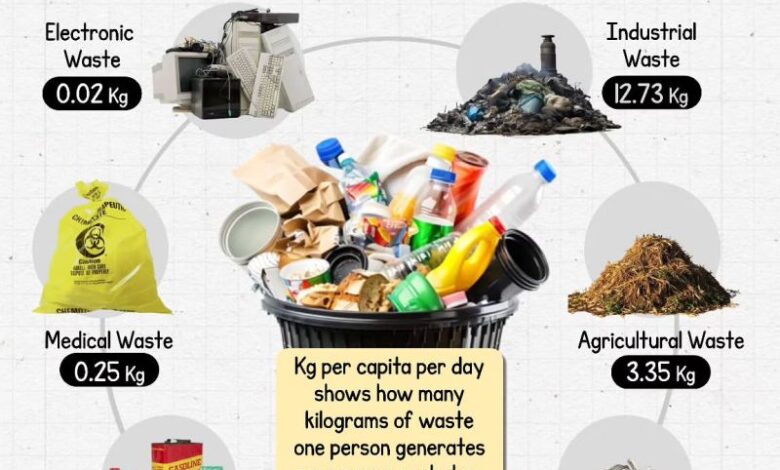
The average person is associated with nearly 19 kilograms of waste every day, but surprisingly, the trash we place at the curb represents only a fraction of that total. Most waste is generated long before a product reaches our homes. It is created during the extraction of raw materials, industrial manufacturing, agricultural production, mining, construction, and transportation.
Every product we purchase from a smartphone and a cotton T-shirt to a loaf of bread or a cup of coffee—carries an invisible waste footprint. Behind every finished product lies a complex chain of discarded materials, production residues, packaging waste, and resource losses that most consumers never see.
In many ways, our garbage bins tell only the final chapter of a much longer story.
The Invisible Waste Economy
Modern economies are remarkably efficient at hiding waste.
Factories remove production scraps before products reach store shelves. Mining operations generate enormous volumes of waste rock that consumers never witness. Construction projects discard concrete, steel, timber, and packaging long before buildings are occupied. Agricultural systems leave behind crop residues, processing by-products, and food losses throughout the supply chain.
These hidden waste streams often outweigh household waste many times over.
This means the environmental impact of our consumption begins not when we throw something away—but the moment natural resources are extracted from the Earth.
By focusing only on municipal waste and recycling, we risk overlooking the much larger opportunities to reduce waste where it is created in the first place.
Why Recycling Alone Is Not Enough
For decades, recycling has been promoted as one of the most important environmental actions individuals can take. Recycling undoubtedly conserves resources, reduces landfill demand, and lowers energy use for many materials.
However, recycling addresses waste only after it has already been produced.
By the time a product reaches a recycling bin, it has already consumed raw materials, water, energy, transportation, labor, and industrial processing. Much of its environmental footprint has already occurred.
The more important question is not simply:
“How do we recycle more?”
Instead, we should ask:
“How do we prevent waste from being created at all?”
That shift in thinking changes everything.
Moving from Waste Management to Waste Prevention
True sustainability begins long before disposal.
It starts with designing products that require fewer materials, last longer, are easier to repair, and can be reused or remanufactured instead of discarded. It means improving manufacturing efficiency, reducing material losses during production, recovering industrial by-products, and creating supply chains where one industry’s waste becomes another industry’s resource.
This is the core principle of the circular economy.
Unlike the traditional linear model—take, make, use, dispose—a circular economy aims to keep materials circulating at their highest value for as long as possible. Waste is viewed not as an inevitable outcome of economic activity, but as a design failure that can often be prevented.
The goal is not simply to manage waste better.
It is to generate less waste in the first place.
Designing Out Waste
Imagine cities where demolished buildings become material banks for future construction rather than landfill.
Imagine factories where production scraps are continuously fed back
source: