
Lifecyle of a carbon credit
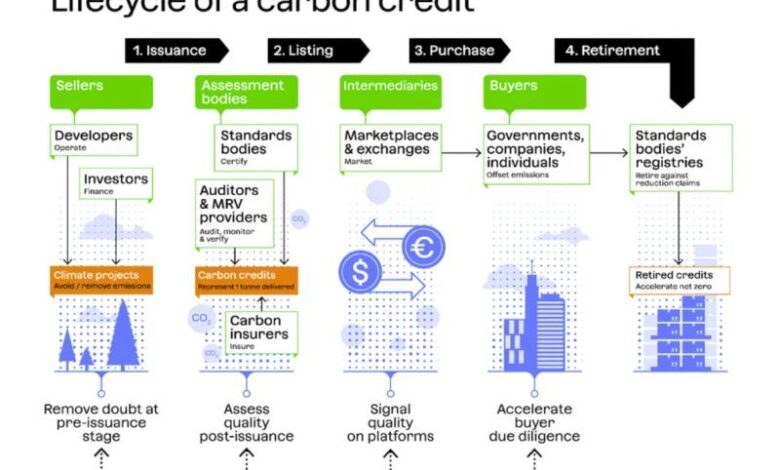
Unpacking the Rigorous Life Cycle of a Carbon Credit
The carbon credit is more than just a financial tool it is the tangible outcome of a structured, scrutinized process designed to ensure climate integrity. Understanding this detailed life cycle is the key to recognizing why high-quality credits are essential for genuinely financing climate action, rather than simply being a tool for offsetting.
Every single credit, representing one tonne of CO2 avoided or removed, carries a complex, rigorous story built on a chain of checks and balances.
The Six Stages of a Trustworthy Carbon Credit
The journey of a carbon credit transforms a climate idea into a verifiable, tradable asset:
1. Conception & Funding (Project Development)
The cycle begins with developers and investors. They are the visionaries who conceptualize, design, and secure the necessary capital to fund a climate project. These projects must demonstrably reduce or remove greenhouse gas (GHG) emissions (e.g., reforestation, clean energy installation, or methane capture).
2. Certification & Registration (Standards Bodies)
This is the stage where credibility is built. The project must submit a detailed plan (methodology) to a recognized standards body (like Verra, Gold Standard, or others). The standard body rigorously assesses the project to ensure it meets criteria such as additionality (the project would not have happened without the credit finance) and permanence. Once approved, the project is registered.
3. Monitoring, Reporting, & Verification (MRV Auditors)
This is the operational backbone. The project’s actual performance and emission reductions are continuously monitored and reported. Crucially, an independent third-party MRV (Monitoring, Reporting, and Verification) auditor is brought in to thoroughly verify the results. This independent check is essential to guarantee that the claimed reductions actually occurred.
4. Issuance & Listing
Only after the rigorous verification stage is passed and the results are certified do the carbon credits get formally issued by the standards body. These issued credits are then listed on various marketplaces or exchanges, making them available for trade.
5. Transaction (Marketplace & Intermediaries)
In this stage, intermediaries connect authentic, verified projects with buyers. Buyers ranging from governments and large corporations to small businesses and individuals purchase these credits. The purpose of the purchase is evolving, moving beyond simple offsetting to actively financing the real climate action embedded within the project.
6. Retirement (The Final Step)
The lifecycle concludes with retirement. When a buyer retires a credit, it is permanently removed from circulation on the public registry. This critical step prevents the credit from ever being resold or double-counted, thus protecting the integrity and ensuring the environmental benefit is realized just once.
The Core Lesson
The entire process serves as a profound reminder: Carbon markets are powerful tools for funneling private capital into necessary climate mitigation, but only when we commit to the rigorous system that makes a credit trustworthy. This structure ensures that every dollar spent is backing a verified, scrutinized, and impactful effort to clean up our atmosphere.


