Linear vs circular economy
The Great Loop: Why the Future of Growth is Not a Straight Line
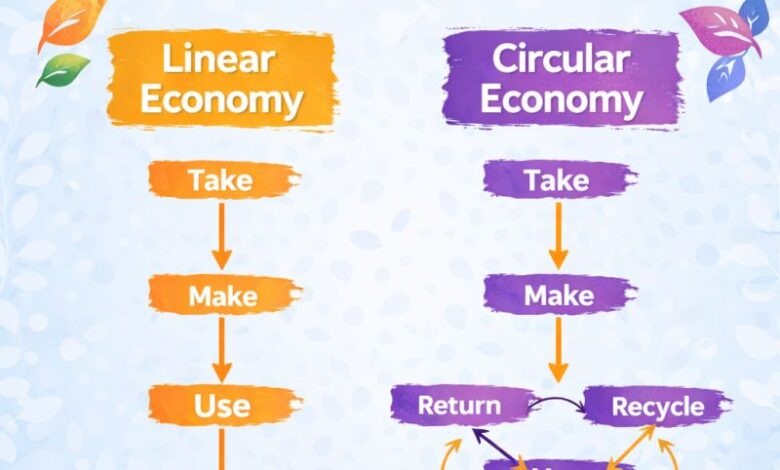
For over a century, the global engine has run on a “Take-Make-Waste” philosophy. We extract, we build, we use, and then almost as an afterthought we bury. This linear path has powered incredible industrial growth, but it has hit a wall. In a world of finite resources, a straight line eventually runs out of room.
The Circular Economy is the elegant solution to this 100-year-old error. It is a system designed to mimic nature, where “waste” simply doesn’t exist.
1. The Death of the “Throwaway” Culture
In a linear system, value is lost the moment a consumer opens a box. In a circular system, that value is harvested.
Instead of a product’s life ending in a landfill, it enters a series of continuous loops:
- Maintain & Prolong: Designing for durability so products don’t break.
- Reuse & Redistribute: Keeping products in the hands of users longer.
- Refurbish & Remanufacture: Returning “tired” products to a like-new state.
- Recycle: As a last resort, turning the molecular components back into raw materials.
2. Design as a Catalyst
Circular thinking starts on the drawing board, not at the garbage bin. We are seeing a revolution in Design for Disassembly. Imagine a smartphone held together by magnetic points rather than toxic glues, or a sneaker made of a single material that can be melted down and 3D-printed into a new pair in an hour.
When we design for the “next life” of a product, we stop managing waste and start managing assets.
3. The Economic Logic of the Circle
The shift from “Ownership” to “Usership” is transforming business. Why buy a lightbulb when you can buy “lumens”? Companies like Signify now sell light-as-a-service, where they own the hardware and have every incentive to make it last forever and use minimal energy.
| The Linear Risk | The Circular Opportunity |
| Resource Scarcity: Volatile prices for raw materials. | Resilience: Secondary materials are already in the loop. |
| Regulatory Pressure: Fines for carbon and waste. | Innovation: New “Product-as-a-Service” revenue. |
| Environmental Toll: Ecosystem collapse. | Regeneration: Restoring natural systems while growing. |
Moving the Needle: From Extraction to Regeneration
The circular economy is more than a recycling program; it is a total rethink of our relationship with the Earth. It recognizes that the most “high-tech” solution we have is the ability to keep what we already have in motion.
By closing the loop, we aren’t just saving the planet. We are building an economy that is more resilient, more creative, and infinitely more sustainable.