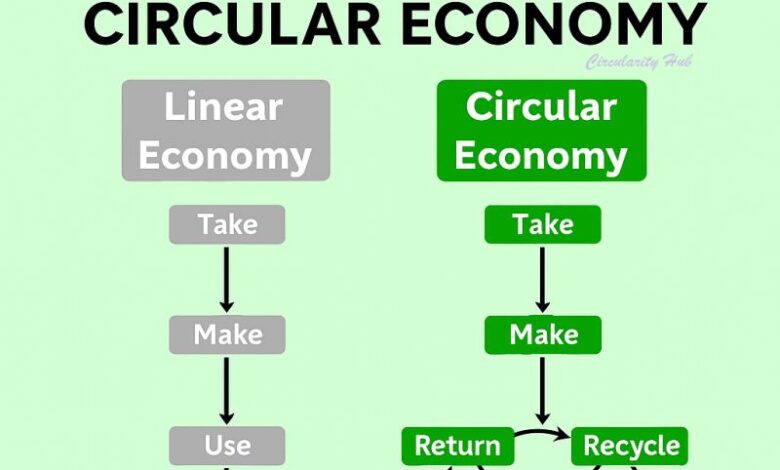
Linear vs cricular economy
The Great Redesign Trading a Fragile Past for a Circular Future
For over a century, the engine of global prosperity has run on a “one-way street.” We have operated under a seductive but dangerous illusion: that resources are infinite and the earth is a bottomless pit for our leftovers.
This is the Linear Economy the era of “Take, Make, Use, and Toss.” While it fueled the industrial revolution and filled our homes with goods, the bill has finally come due in the form of depleted mines, choked oceans, and a climate in crisis.
The limits of the linear world haven’t just been reached; they are being breached.
The Architecture of the “Take-Make-Waste” Model
In a linear system, value is created at the point of sale and destroyed at the point of disposal. It is a system built on planned obsolescence and fragility.
- Resource Hunger: It demands a constant injection of “virgin” materials.
- Supply Chain Vulnerability: When raw materials become scarce or geopolitically contested, the entire system stutters.
- The Waste Legacy: Everything we produce is eventually destined for a landfill, representing a total loss of the energy, labor, and materials invested.
The Circular Revolution: Designing Out Waste
A Circular Economy isn’t just about “recycling more.” It is a fundamental rewiring of how we conceive value. It replaces the straight line with a continuous, pulsating loop: Take → Make → Use → Return → Repair → Refurbish → Regenerate.
In this new logic, a “product” is simply a temporary vessel for valuable materials that must eventually return to the system.
The New Pillars of Value:
- Design for Longevity: Products are built to be opened, repaired, and upgraded—not replaced.
- Product-as-a-Service: Why own a lightbulb when you can buy “illumination”? Companies maintain ownership of the hardware, ensuring it is designed for maximum efficiency and easy recovery.
- Closed-Loop Supply Chains: Yesterday’s smartphone becomes the raw material for tomorrow’s medical device.
The Economic Case: Resilience as a Competitive Edge
Circularity isn’t just an environmental “good deed”; it is a massive economic opportunity. By decoupling growth from resource extraction, businesses can:
- Shield themselves from price volatility: Using recycled materials reduces dependence on unpredictable global commodity markets.
- Unlock Innovation: Moving to remanufacturing and “sharing” models creates high-value green jobs that can’t be easily automated or outsourced.
- Build Customer Loyalty: Repair and refurbishment services create ongoing relationships with consumers rather than one-off transactions.
The Verdant Horizon: Smarter, Not Just Less
The transition is already gaining momentum in fashion houses, construction sites, and energy grids. We are moving away from the “guilt-based” environmentalism of “using less” and toward the “innovation-based” reality of “using smarter.”
“The future is not about how much we can extract, but about how intelligently we can keep what we already have in motion.”
Linear systems were built for a world that no longer exists. Circular systems are being built for the world we intend to keep. The real question is no longer if your industry will go circular, but whether you will be the one designing the loop—or the one left outside of it.