
Nature already solved flooding
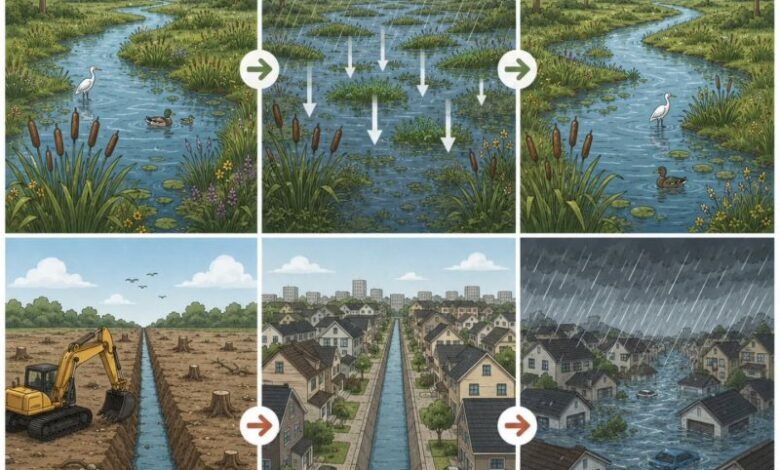
The Anatomy of a Living Sponge
To understand why concrete fails where nature succeeds, look at how a healthy wetland handles a deluge. Wetlands do not fight the water; they accommodate it.
- The Sponge Effect: A single acre of wetland can store up to 3.3 million liters of water (roughly 1.5 Olympic-sized swimming pools). When a storm hits, the soil and dense vegetation slow down the rush of water, absorbing the peak force of the flood like a massive, natural sponge.
- The Velocity Brake: In a paved city, water hits concrete and accelerates, turning rain into a destructive torrent. Wetlands act as a physical brake. The roots of reeds, rushes, and trees trap the kinetic energy of the water, forcing it to drop its sediment and lose its destructive power.
- The Unpaid Water Treatment Plant: As the water sits in the wetland, the ecosystem goes to work. Plants and microbes naturally filter out heavy metals, agricultural runoff, and pollutants. By the time that water seeps into underground aquifers or flows into rivers, it is cleaner than when it entered.
Gray Infrastructure vs. Green Infrastructure
For decades, urban engineering favored “gray infrastructure”—dams, concrete canals, and seawalls. But gray infrastructure is rigid; it works until it breaks, often catastrophically. “Green infrastructure,” like wetlands, is dynamic and resilient.
| Gray Infrastructure (Concrete) | Green Infrastructure (Wetlands) |
| Response to Stress: Cracks, overflows, or fails when design capacity is exceeded. | Response to Stress: Flexes and expands; the more water it receives, the more it spreads out. |
| Economic Lifecycle: Depreciates instantly; requires constant, multi-million dollar maintenance. | Economic Lifecycle: Appreciates over time; grows more resilient as the ecosystem matures. |
| Ecological Footprint: Destroys local habitats and displaces wildlife. | Ecological Footprint: Acts as a biodiversity hotspot, supporting 40% of all global species. |
The Cost of Forgetting: We are losing wetlands three times faster than forests. When we pave over a marsh to build a subdivision, we aren’t creating value; we are shifting a massive financial liability onto the next generation.
Resilient cities cannot be built out of concrete alone. True climate resilience requires a shift in perspective: recognizing that a swamp, a marsh, or a mangrove forest isn’t a blank canvas waiting for development it is an active, vital piece of civil defense that protects our communities before the next storm hits.
source:
https://www.linkedin.com/posts/climatechange-wetlands-nature-share-7476891309564264448-6Kfq/


