Sustainability key abbreviations
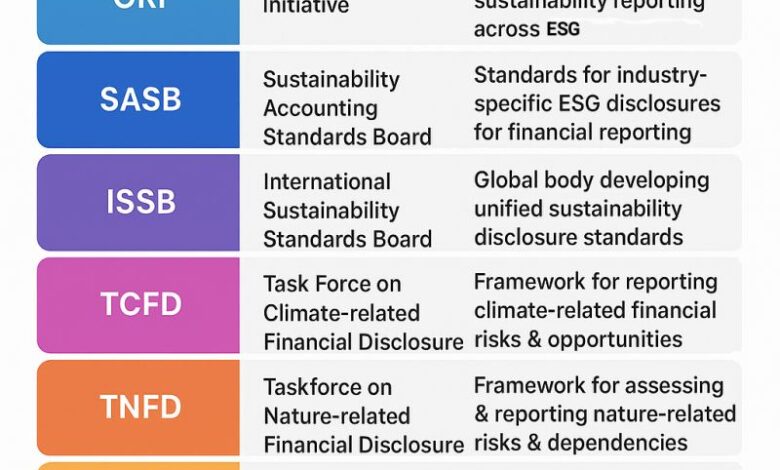
Navigating the Alphabet Soup of Sustainability: Your Essential Guide
Confused between all these sustainability standards and frameworks? You’re not alone. The global sustainability landscape is full of acronyms, and each one plays a critical role.
Think of them as tools in a sustainability toolkit. Here is a simple, clear, and organized breakdown to help you understand not just what they are, but how they fit together.
I. The Core Reporting & Disclosure Frameworks
These are the primary structures companies use to measure, manage, and communicate their impact.
| Abbreviation | Full Name | Primary Focus | Key Purpose |
| ESG | Environmental, Social & Governance | Broad operational evaluation. | A broad framework to evaluate how responsibly a company operates (impact, worker practices, ethics). |
| GRI | Global Reporting Initiative | Comprehensive impact reporting. | A globally recognized reporting standard guiding organizations on what and how to disclose sustainability impacts. |
| SASB | Sustainability Accounting Standards Board | Investor-focused financial disclosure. | Provides industry-specific disclosure standards used primarily for financial reporting and investor decision-making. |
| ISSB | International Sustainability Standards Board | Global harmonization. | A global standard-setter (under IFRS) working to bring consistency and comparability to sustainability disclosures worldwide (IFRS S1 & S2). |
II. The European Union’s Regulatory Powerhouses
The EU is leading the charge in mandating transparency and accountability. These regulations are setting a global benchmark.
- CSRD (Corporate Sustainability Reporting Directive):The Transparency Mandate. An EU regulation requiring large and listed companies to report detailed, audited sustainability performance with high transparency. It shifts focus from ‘what is material to investors’ to ‘what is material to the world’ (Double Materiality).
- CSDDD (Corporate Sustainability Due Diligence Directive):The Accountability Law. An EU law requiring companies to proactively identify, prevent, and address human rights and environmental impacts across their entire value chains.
- SFDR (Sustainable Finance Disclosure Regulation):Fighting Greenwashing. An EU regulation requiring financial institutions to disclose how sustainable their investments truly are, promoting clarity and reducing misleading claims.
- CBAM (Carbon Border Adjustment Mechanism):The Climate Tariff. A tariff applied to imported products based on their carbon emissions, designed to ensure fair climate competition and prevent “carbon leakage” (moving production to countries with laxer rules).
III. The Risk & Nature Focus
These frameworks shift the focus from general reporting to specific, critical global risks.
- TCFD (Task Force on Climate-related Financial Disclosures):The Climate Risk Blueprint. Helps organizations disclose climate-related financial risks and opportunities, focusing on four pillars: Governance, Strategy, Risk Management, and Metrics.
- TNFD (Taskforce on Nature-related Financial Disclosures):The Biodiversity Mandate. Similar to TCFD, but focused on nature. It supports companies in identifying and reporting dependencies and risks related to biodiversity and ecosystems.
IV. The Global Context & Ambition
These overarching initiatives provide the moral compass and global goals for all corporate action.
- UNGC (United Nations Global Compact):The Principles Pledge. A voluntary initiative where companies commit to 10 universally accepted principles for responsible business practices (covering human rights, labor, environment, & anti-corruption).
- SDGs (Sustainable Development Goals):The 2030 Roadmap. 17 global goals set by the UN to achieve a more sustainable, equitable, and peaceful world by 2030. They provide the universal ‘North Star’ for impact.
The Big Picture: Why This Matters
This “alphabet soup” is not just bureaucracy; it is the infrastructure for a sustainable global economy.
- For Investors: ISSB, SASB, and TCFD provide the data to assess financial risk and opportunity.
- For Regulators: CSRD, CSDDD, and SFDR provide the teeth to enforce transparency and ethical conduct.
- For Companies: GRI and the UNGC provide the guidance and principles to manage their broad impact effectively, contributing to the ultimate mission of the SDGs.