The challenge of slums – global report on human settlements 2003
A Structural Analysis of Global Urban Poverty
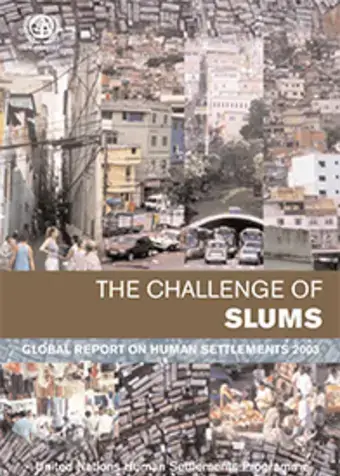
Published by UN-Habitat, The Challenge of Slums: Global Report on Human Settlements 2003 stands as a landmark assessment of informal urban settlements. It presents a comprehensive evaluation of slum dynamics, examining the root causes of their expansion, their spatial and economic characteristics, and the evolution of global housing policies.
The report delivers a critical warning: without targeted, systemic intervention, global slum populations will continue to surge, escalating humanitarian and economic strains in rapidly urbanizing regions.
1. The Scale and Causes of Global Slum Formation
At the turn of the 21st century, the report estimated that nearly 1 billion people approximately 1 in every 3 urban dwellers worldwide—lived in slum conditions, with the vast majority concentrated in the Global South.
                         DRIVERS OF SLUM EXPANSION
                                     │
         ┌───────────────────────────┼───────────────────────────┐
         ▼                           ▼                           ▼
  Rapid Rural-to-Urban        Labor Market              Institutional & Land
       Migration              Informalization              Market Failures
 ────────────────────────   ────────────────────   ──────────────────────────────
 Driven by agricultural     Urban economies fail    Inadequate public housing,
 decline & economic         to generate sufficient  exclusionary zoning, and lack
 centralization in cities.  formal sector jobs.     of tenure security.
The report identifies slum creation not as an inevitable byproduct of urbanization, but as the direct outcome of policy failures, market distortions, and structural inequalities:
-
Unprecedented Urbanization: Rapid rural-to-urban migration, combined with natural population growth, outpaced municipal infrastructure capacity.
-
Economic Informalization: The expansion of the informal economy left millions without stable wages, pricing them out of formal housing markets.
-
Failures in Land Governance: Inflexible zoning laws, lack of clear property rights, and speculative land markets forced low-income populations into hazardous or illegally occupied areas.
2. Key Characteristics of Informal Settlements
UN-Habitat operationalized the definition of a slum based on five core physical and legal deficiencies:
| Dimension | Deficit / Operational Challenge |
| Inadequate Access to Safe Water | Insufficient quantity or unaffordable access to potable water. |
| Inadequate Access to Sanitation | Lack of private or shared toilet facilities connected to proper waste management. |
| Poor Structural Quality | Dwellings built with non-durable materials in hazardous locations (e.g., floodplains, steep slopes). |
| Overcrowding | Insufficient living space (more than three people per room). |
| Insecure Tenure Status | Constant threat of forced eviction due to lack of formal documentation or legal recognition. |
Beyond physical deprivation, slums act as spatial poverty traps isolating residents from formal employment, quality education, healthcare, and basic municipal protection.
3. The Paradigm Shift in Housing Policy
The report traces the evolution of international policy responses over the late 20th century, highlighting a shift from destructive intervention toward participatory upgrading:
  1960s – 1970s               1970s – 1980s               1990s – Present
┌───────────────┐           ┌───────────────┐           ┌───────────────┐
│ Slum Clearance│    ──►    │ Sites & Services │   ──►  │ In-Situ Slum  │
│  & Evictions  │           │   Programs    │           │   Upgrading   │
└───────────────┘           └───────────────┘           └───────────────┘
  Failed to stop              Relocated poor to           Focuses on tenure
  growth; destroyed           peripheries; failed         security, basic
  social safety nets.         to scale effectively.       infra & community
                                                          participation.
-
Slum Clearance & Evictions (1960s–1970s): Eradication policies failed because they destroyed affordable housing stock and displaced communities without offering viable alternatives.
-
Sites and Services Schemes (1970s–1980s): Governments provided serviced land for self-building. While an improvement, these programs often failed to reach the poorest populations due to high cost-recovery demands and remote locations.
-
In-Situ Slum Upgrading (1990s onward): The report advocates for in-situ upgrading improving existing infrastructure (water, roads, sanitation, power) and granting legal tenure without displacing communities.
4. Strategic Framework for Action
To achieve the Millennium Development Goals (Target 11: significantly improving the lives of at least 100 million slum dwellers by 2020), the report outlines four strategic imperatives for governments and international organizations:
-
Secure Tenure: Legitimizing land occupancy through land titling or flexible tenure frameworks protects residents from eviction and encourages private investment in home improvement.
-
Pro-Poor Urban Governance: Municipalities must decentralize budgeting and integrate informal settlements into official city master plans rather than treating them as invisible entities.
-
Infrastructure Investment: Public funding must prioritize basic utility coverage (clean water, drainage, waste collection) to lower public health risks.
-
Economic Inclusion: Linking upgrading projects with local employment opportunities (e.g., hiring residents for infrastructure construction) helps lift households out of structural poverty.
The Challenge of Slums concludes that slums are not isolated pockets of poverty, but a fundamental feature of unequal urban development. Sustainable cities depend on shifting from reactive eradication to proactive, rights-based urban planning that integrates informal communities into the broader economic and social fabric.
source:
https://unhabitat.org/the-challenge-of-slums-global-report-on-human-settlements-2003