
The Hidden Cost of Deforestation
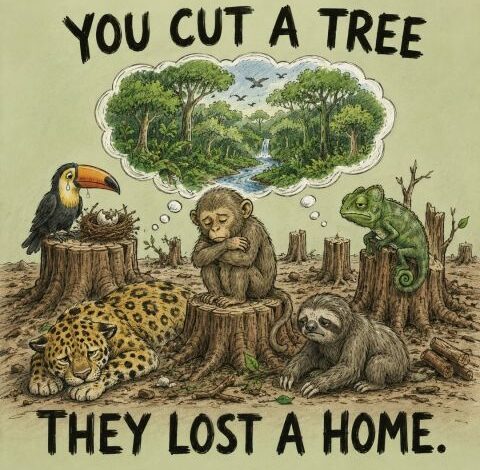
The Hidden Cost of Deforestation
Cutting down a tree is not just an environmental loss.
It is an economic decision with global consequences.
Forests are among the world’s most valuable natural assets. They regulate rainfall, absorb carbon emissions, protect biodiversity, stabilize soil, support agriculture, and sustain millions of livelihoods and industries.
Yet every year, vast areas of forests disappear for short-term economic gain.
And the true cost is rarely included in the balance sheet.
When forests vanish, ecosystems collapse. Wildlife loses habitat. Communities become more vulnerable to floods, droughts, and heatwaves. Supply chains face increasing disruption. Food systems weaken. Insurance losses rise. Infrastructure risks grow. Carbon emissions accelerate.
Climate change and economic instability are becoming deeply interconnected.
According to global environmental assessments, deforestation contributes significantly to greenhouse gas emissions while reducing the planet’s ability to absorb carbon naturally. At the same time, nature loss threatens more than half of global GDP that depends directly or indirectly on ecosystem services.
Nature is not separate from the economy.
Nature is the foundation of the economy.
Protecting forests is no longer only a conservation issue.
It is a business, climate, and financial imperative.
The transition toward sustainable forestry, regenerative land management, circular economies, and nature-positive investment is becoming essential for long-term resilience and economic stability.
Because every tree removed without restoration creates a debt future generations will eventually pay.
A healthy economy cannot exist on a dying planet.


