The pencil that doesn’t end in the trash
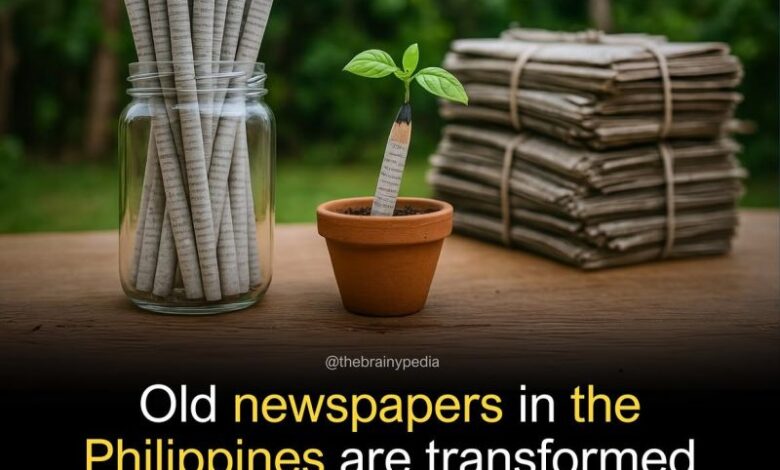
From Old Newspapers to Basil
What if a pencil could have a second life after it was no longer useful for writing?
Every year, countless pencils eventually become too short to hold comfortably and are discarded. Most are designed with a simple linear lifecycle: make, use, throw away.
But innovators in the Philippines are showing that even something as ordinary as a pencil can be redesigned around the principles of the circular economy.
From Old Newspapers to a New Plant
Startups such as Eco Hub Cebu and Usbong have developed plantable pencils using recycled newspapers. Instead of relying entirely on conventional wood, the pencil body is handcrafted from repurposed paper, helping give discarded materials a new purpose.
The most interesting part comes at the end of the pencil.
Instead of a conventional eraser, some versions contain a small biodegradable seed capsule. Once the pencil becomes too short to use, the remaining piece can be planted in soil, watered, and cared for.
Depending on the seed variety, the pencil can potentially grow into plants such as basil, mint, tomatoes, sunflowers, or other herbs and flowers.
In other words:
The end of the pencil becomes the beginning of something else.
More Than Just Waste Reduction
The idea is interesting not simply because it is biodegradable or plantable, but because it challenges the way we traditionally think about product design.
A conventional product often follows a linear pathway:
Raw materials → Production → Consumption → Waste
A circular approach asks a different question:
“What happens after the product has served its original purpose?”
With a plantable pencil, the answer can be:
Use → Plant → Grow → Return value to nature
This does not eliminate the environmental footprint of manufacturing or transportation, and a plantable pencil should not be viewed as a complete solution to waste. However, it demonstrates an important principle: products can be designed with their next life in mind.
Sustainability Can Create Social Value Too
The story also goes beyond materials.
In the case of Usbong, the pencils are handcrafted by local mothers in Milaor, Camarines Sur. This connects sustainable product design with local livelihood creation, demonstrating how environmental innovation can potentially generate social and economic benefits at the same time.
This is an important dimension of sustainability.
A product becomes more meaningful when it does not only reduce waste, but also considers who makes it, how materials are sourced, what happens after use, and what value is created for communities.
Small Product, Bigger Lesson
The circular economy does not always require sophisticated technology, massive infrastructure, or billion-dollar investments.
Sometimes, it begins with something much simpler:
Rethinking an everyday object.
A pencil is a small product. But imagine if millions of everyday products were designed to be reused, repaired, recycled, composted, regenerated, or transformed into something useful after their first life.
The impact could extend far beyond the product itself.
The real innovation is not simply creating a pencil that grows basil.
It is changing the question from:
“How do we make this product?”
to:
“What value can this product create after we are finished using it?”
That shift from disposal to regeneration is at the heart of a more circular economy.
source: