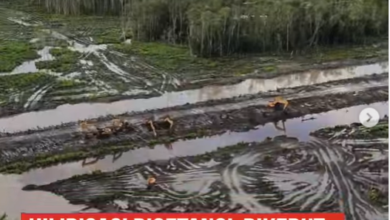
The world has entered a new era of ‘water bankruptcy’ with irreversible consequences

The United Nations has issued a stark declaration: the age of reliable water is over. We have officially entered an era of “Global Water Bankruptcy,” a state where humanity’s “spending” of water vastly exceeds the Earth’s ability to replenish it.
Unlike a financial crisis, there is no bailout for the hydrological cycle. These changes are moving toward a point of no return.
1. The Signs of Systemic Collapse
The world’s “liquid assets” our rivers, lakes, and aquifers are being drained to the point of structural failure.
- Drying Basins: More than 50% of the world’s large lakes have significantly shrunk since 1990.
- Invisible Depletion: 70% of our major aquifers (the deep underground reservoirs we rely on for agriculture) are in a state of long-term decline. Unlike surface water, once these are depleted or contaminated, they can take thousands of years to recover.
- Human Toll: 4 billion people over half the global population now endure severe water scarcity for at least one month every year.
2. Living Beyond Our “Hydrological Means”
Kaveh Madani, a leading voice on this crisis, warns that we are trying to sustain 21st-century economies on a 20th-century water budget that no longer exists.
- Agriculture as a Driver: Farming accounts for roughly 70% of global freshwater withdrawals. As we grow more food to support a rising population, we are effectively “exporting” water from drought-stricken regions to wealthy ones.
- Climate Feedback Loops: Warming temperatures don’t just melt ice; they accelerate evaporation and shift rain patterns, meaning that even when it does rain, the water often falls in floods that the dry soil cannot absorb.
3. The “Bankruptcy” Strategy: From Extraction to Stewardship
To survive this era, the report demands a fundamental shift in how we value every drop. We cannot “produce” more water; we can only manage what remains.
| The Old Paradigm | The New “Solvency” Plan |
| Expansion: Digging deeper wells and damming more rivers. | Conservation: Transforming farming via precision irrigation and drought-resistant crops. |
| Reaction: Emergency aid during droughts. | Resilience: Protecting and restoring wetlands, which act as natural “water banks.” |
| Invisibility: Guessing water levels in aquifers. | Monitoring: Implementing high-tech, real-time tracking of global water usage. |
4. Why This Matters: The Economic Domino Effect
Water bankruptcy is not just an environmental issue; it is a threat to global stability.
- Food Security: Collapsing water cycles lead to crop failures and skyrocketing food prices.
- Energy: Hydroelectric power and the cooling of nuclear/thermal plants depend on consistent water flow.
- Conflict: As water crosses borders, scarcity becomes a catalyst for geopolitical tension and mass migration.
The UN’s message is clear: the hydrological status quo is dead. We are currently “liquidating” the planet’s life support system to pay for temporary economic growth. Moving forward, “water solvency” must become the primary metric for any sustainable society. We are no longer waiting for a crisis; we are learning to live in the aftermath of one.