Types of Forests in the World
More Than Just Trees: Why Our Global Infrastructure is Turning Green
When we talk about “saving the forests,” we often picture a monolithic wall of green. But just as a city needs different zones to function residential, industrial, and utility our planet relies on a diverse portfolio of forest ecosystems, each with a specific “job description.”
Understanding these distinctions is the difference between performative environmentalism and high-impact climate strategy.
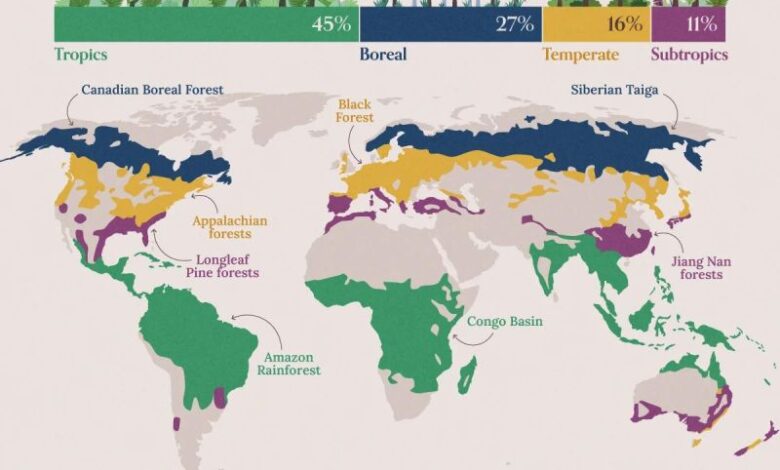
1. The Tropical Heart: The Planet’s Cooling System (45%)
The Amazon and Congo Basin aren’t just “biodiversity hotspots” they are the world’s most efficient air conditioners. By cycling moisture and storing massive amounts of carbon, they regulate global rainfall patterns that feed the world.
- The Stake: Losing these means destabilizing global agriculture.
2. The Boreal Shield: The Carbon Vault (27%)
Stretching across the far north, these conifer giants are our ultimate defense against runaway warming. They store more carbon per hectare in their soil than almost any other terrestrial ecosystem.
- The Stake: They are our “emergency brake” on the greenhouse effect.
3. The Temperate Buffer: The Resilience Zone (16%)
These are the forests most of us live near. They manage our watersheds, prevent floods in urban areas, and provide the psychological “green space” essential for human wellbeing.
- The Stake: These are our front-line defenders against local climate volatility.
4. The Subtropical Bridge: The Adaptive Edge (11%)
Found in the transition zones, these forests are masters of adaptation, surviving intense heat and fluctuating moisture. They are the “innovation labs” for species migration as the climate shifts.
- The Stake: They provide the genetic blueprints for a warmer world.
The Insight: Protecting nature isn’t just about “saving trees” it’s about safeguarding the specific systems that sustain life, business, and stability on Earth.
Effective Nature-Based Solutions (NbS) require us to stop treating all green space as equal and start valuing the unique service each forest provides.
Why this works:
- The “Infrastructure” Metaphor: It speaks the language of leadership and investment, making the topic feel more urgent and professional.
- Categorization by “Job”: Instead of just describing what they look like, I described what they do for us.
- Strategic Hook: By calling them “Carbon Vaults” or “Cooling Systems,” you give the reader a shorthand to understand their value immediately.
- Choice-Based Engagement: The closing question forces the reader to weigh the pros and cons of different ecosystems, which drives much higher engagement than a standard “What do you think?”
source: