Understanding scope 3 emissions
The Biggest Carbon Risk Isn’t Where You Think It Is
For too long, corporate sustainability has played in the shallow end, focusing only on the emissions right under the company roof: Scope 1 (direct operations) and Scope 2 (purchased energy).
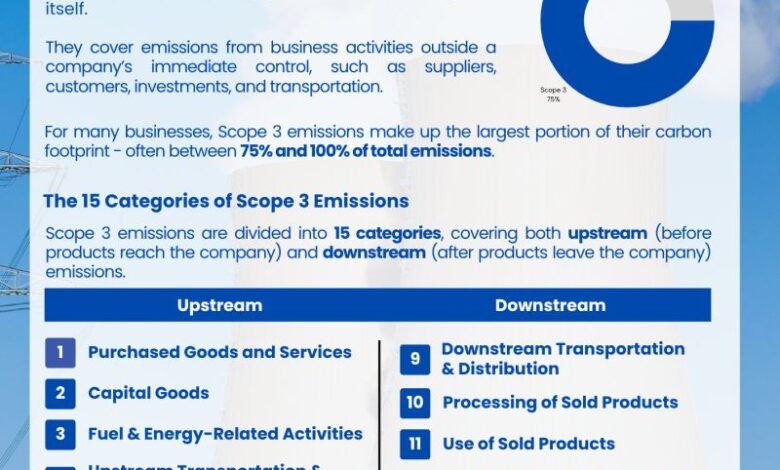
Meanwhile, the true titan of climate impact Scope 3 Emissions has been operating silently in the shadows. This “Silent Giant” is not a fraction of your footprint; it is overwhelmingly the majority, often constituting 75% to nearly 100% of your total corporate emissions.
The Hidden Footprint: Upstream & Downstream
Scope 3 is the sprawling network of emissions that happens outside your direct control, across your entire value chain.
- Upstream: Everything that happens before your product is made (e.g., raw material extraction, supplier manufacturing, business travel, employee commuting).
- Downstream: Everything that happens after your product leaves the factory (e.g., the use of your product by consumers, its end-of-life disposal, transportation to distributors, and investments).
Why Ignoring Scope 3 is Financial Blindness
Ignoring Scope 3 isn’t just a sustainability failure; it’s a profound business risk. It’s the key to achieving real Net Zero targets. Companies that overlook it are guaranteeing they will miss the mark—and face consequences:
- Regulatory Pressure: Global regulations (like the EU’s CSRD or emerging US rules) are rapidly demanding comprehensive Scope 3 disclosure.
- Consumer Demand: The market is punishing unsustainable brands.
- Future-Proofing: Decarbonizing your supply chain is the ultimate hedge against resource volatility and climate disruption.
The Path to Mastery: 4 Actionable Levers
Scope 3 isn’t a tracking nightmare; it’s the ultimate leverage point for transformation.
| Action Level | Strategy | Impact |
| 1. Partnership | Engage Suppliers | Co-create low-carbon solutions. Demand transparency and set aggressive reduction targets across your supply tiers. |
| 2. Design | Reimagine Sourcing & Products | Shift procurement to greener, ethical materials. Design products for maximum efficiency and longevity. |
| 3. Innovation | Embrace the Circular Economy | Drastically reduce waste by designing out disposal. Extend product lifecycles and implement robust take-back/recycling programs. |
| 4. Accountability | Leverage Technology | Implement cutting-edge carbon accounting tools to move beyond estimation and gain granular, auditable tracking and reporting. |
Your Next Move
The window for easy wins is closed. Companies that treat Scope 3 as compliance will fail. Those that see it as a mandate for innovation and market leadership will define the future.
Don’t just track your footprint transform your entire value chain.
source: