
𝐔𝐧𝐝𝐞𝐫𝐬𝐭𝐚𝐧𝐝𝐢𝐧𝐠 c𝐢𝐫𝐜𝐮𝐥𝐚𝐫 e𝐜𝐨𝐧𝐨𝐦𝐲 c𝐨𝐧𝐜𝐞𝐩𝐭𝐬 & f𝐫𝐚𝐦𝐞𝐰𝐨𝐫𝐤𝐬
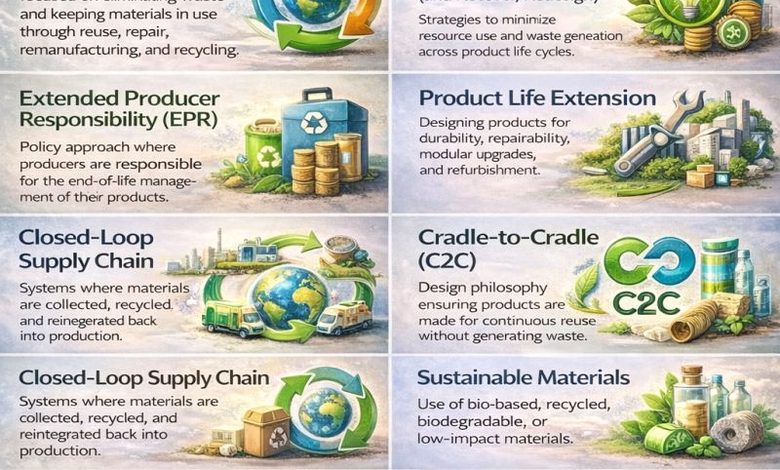
Redefining Value: Strategic Frameworks for the Circular Economy Transition
The global economy is undergoing a structural shift. The traditional linear model Take ──► Make ──► Waste presents escalating supply chain vulnerabilities, regulatory pressures, and material volatility.
Transitioning toward a Circular Economy (CE) offers a regenerative alternative designed to decouple economic growth from finite resource consumption. By preserving material utility, optimizing lifecycle asset management, and designing out waste, circular frameworks redefine how value is created and retained across industrial supply chains.
Core Pillars of Circular Architecture
                       CIRCULAR RESOURCE FLOW ARCHITECTURE

  [ RAW INPUTS ] ──► [ DESIGN & PRODUCTION ] ──► [ DISTRIBUTION ] ──► [ USE PHASE ]
                            ▲                                             │
                            │             Product Life Extension          │
                            ├─────────────────────────────────────────────┤
                            │         (Repair, Refurbish, Remanufacture)  │
                            │                                             │
                            │           Closed-Loop Supply Chain          │
                            └─────────────────────────────────────────────┘
                                           (Recycle & Reintegrate)
1. Product Life Extension & Cradle-to-Cradle (C2C) Design
Under a Cradle-to-Cradle (C2C) design philosophy, products are engineered from inception for non-toxic, continuous material cycles. Rather than treating end-of-life as an afterthought, products utilize modular components and durable architectures to facilitate seamless upgrading, disassembly, and refurbishment.
2. The 3R / 5R Industrial Framework
The operational engine of circularity relies on a prioritized hierarchy of material intervention:
$$\text{Redesign} \longrightarrow \text{Reduce} \longrightarrow \text{Reuse} \longrightarrow \text{Recycle} \longrightarrow \text{Recover}$$
By prioritizing Redesign and Reduce upstream, organizations prevent secondary emissions and processing costs long before material waste is generated downstream.
3. Closed-Loop Supply Chains & Waste-to-Resource Conversion
In a closed-loop system, reverse logistics networks collect post-consumer products and industrial byproducts, converting waste streams directly into secondary raw materials or energy inputs. This shields businesses from price volatility in virgin commodities while minimizing landfill dependency.
Comparative Analysis: Circular Business Models
| Business Model | Primary Operational Mechanic | Industry Impact & Revenue Realization |
| Product-as-a-Service (PaaS) | Ownership remains with the manufacturer; customers pay for usage or performance outcomes. | Incentivizes long-lasting, easily repairable product design to maximize manufacturer margin over time. |
| Remanufacturing & Refurbishment | Restoring used, worn products to original performance standards with warranties. | Retains up to $85\%$ of embodied energy and material value compared to virgin production. |
| Sharing Platforms | Digital marketplaces that optimize asset utilization rates across multiple users. | Capitalizes on underutilized fixed assets, reducing aggregate demand for single-user goods. |
| Extended Producer Responsibility (EPR) | Regulatory and policy mandates holding brands accountable for product end-of-life management. | Shifts financial responsibility for post-consumer waste management back to original manufacturers. |
source:
https://lnkd.in/p/gQfpyNRc


