Tahukah Anda
20 Essential carbon & climate
The 20 Carbon & Climate Terms Every Executive Must Master
Understanding climate terminology is no longer just an ESG compliance requirement it is a core business strategy. As regulatory pressures mount (from CSRD to SEC rules) and global supply chains decarbonize, misinterpreting climate vocabulary can lead to reputational damage, regulatory penalties, or wasted capital.
Here is an actionable, structured guide to the 20 essential carbon and climate terms every leader and sustainability professional needs to know.
1. Greenhouse Gas Protocol & Emission Scopes
Understanding your carbon footprint begins with categorizing emissions according to the standard GHG Protocol framework:
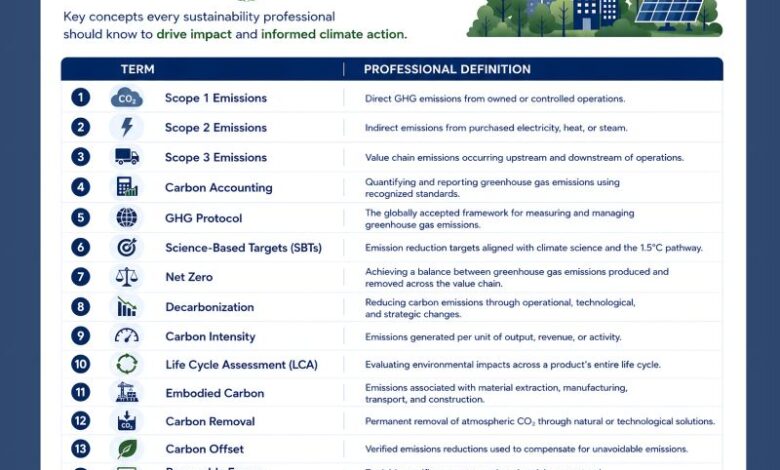
- 1. Scope 1 Emissions (Direct Emissions): Greenhouse gas emissions that occur directly from sources controlled or owned by an organization (e.g., fuel burned in company vehicles, boilers, or manufacturing equipment).
- 2. Scope 2 Emissions (Indirect Energy Emissions): Emissions associated with the purchase of electricity, steam, heating, or cooling consumed by the reporting company.
- 3. Scope 3 Emissions (Value Chain Emissions): All other indirect emissions occurring across the entire value chain both upstream (purchased goods, supplier logistics, employee commuting) and downstream (product use and end-of-life disposal). Scope 3 often represents 80–90% of a company’s total impact.
- 4. Carbon Accounting: The systematic methodology of measuring, quantifying, and tracking an organization’s greenhouse gas emissions using carbon management software, emissions factors, and financial data.
- 5. CO2e (Carbon Dioxide Equivalent): The standard metric used to compare and aggregate emissions from different greenhouse gases (such as methane, nitrous oxide, and fluorinated gases) based on their Global Warming Potential (GWP) relative to carbon dioxide.
2. Decarbonization Targets & Strategy
- 6. Net Zero: A state achieved when an organization actively reduces its greenhouse gas emissions as close to absolute zero as possible (typically > = 90% reduction across Scopes 1, 2, and 3) and neutralizes any residual, unavoidable emissions through permanent carbon removal.
- 7. Carbon Neutrality: Balancing emitted carbon with an equivalent amount offset or sequestered. Unlike Net Zero, Carbon Neutrality can be claimed immediately through carbon offsets without requiring deep internal emission reductions first.
- 8. SBTi (Science Based Targets initiative): A global corporate governance body that validates whether a company’s carbon reduction targets align with climate science (specifically limiting global warming to 1.5°C under the Paris Agreement).
- 9. Double Materiality: A reporting framework requiring companies to assess two perspectives: how sustainability issues impact their financial performance (outside-in) and how their operations impact society and the environment (inside-out).
3. Tech, Offsets & Removal Mechanisms
- 10. CCUS (Carbon Capture, Utilization, and Storage): Technologies designed to capture CO2 emissions directly at industrial point sources or from ambient air (Direct Air Capture), then either utilize it in industrial processes or store it permanently underground.
- 11. Carbon Offsets: Financial credits representing one metric ton of CO2e mitigated or removed by an external project elsewhere (e.g., renewable energy projects or reforestation).
- 12. Carbon Insetting: Direct investments by a company to reduce emissions or enhance carbon sinks within its own value chain (such as supporting regenerative agriculture with existing agricultural suppliers).
- 13. Embodied Carbon: The total greenhouse gas emissions generated during the extraction, processing, transportation, and assembly of building materials and products before they become operational.
4. Policy, Regulatory & Financial Mechanisms
- 14. CBAM (Carbon Border Adjustment Mechanism): A tariff introduced by the European Union on carbon-intensive imports (like steel, cement, and aluminum) to equalize the price of carbon between domestic production and imports, preventing “carbon leakage.”
- 15. TCFD / ISSB Frameworks: Standards established by the Task Force on Climate-related Financial Disclosures (now folded into the International Sustainability Standards Board) for disclosing climate risks, opportunities, governance, and metrics to capital markets.
- 16. Internal Carbon Pricing (ICP): A voluntary monetary value placed on carbon emissions by a corporation to factor environmental impact into internal capital expenditure (CapEx) and operational decision-making.
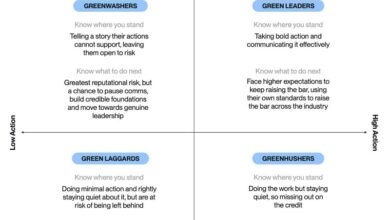
- 17. Greenwashing: Making misleading, unsubstantiated, or exaggerated claims about the environmental benefits or climate performance of a product, service, or corporate strategy.
5. Ecosystems & Land Use
- 18. Nature-Based Solutions (NbS): Actions aimed at protecting, sustainably managing, and restoring natural or modified ecosystems (such as wetlands, mangroves, and forests) that address societal challenges while providing carbon sequestration.
- 19. LULUCF (Land Use, Land-Use Change, and Forestry): A recognized sector within national and corporate GHG reporting that accounts for carbon absorbed or emitted through land management, forestry, and agricultural practices.
- 20. Residual Emissions: The small fraction of greenhouse gas emissions (typically < 10%) that remain impossible or technically infeasible to eliminate after all viable abatement measures have been implemented.
Comparing Key Approaches
| Strategy / Concept | Primary Mechanism | Best Suited For | Risk Factor |
| Decarbonization (Net Zero) | Absolute reduction across value chain (> 90%) | Long-term corporate resilience & compliance | High capital intensity initially |
| Carbon Offsetting | Buying external carbon credits | Compensating for short-term emissions | Claims of greenwashing if over-relied upon |
| Carbon Insetting | Investing inside supply chain ecosystems | Supply chain transformation & Scope 3 reduction | Operational & supplier alignment friction |
| Internal Carbon Pricing | Shadow price on CapEx investments | Driving internal innovation & risk hedging | Requires strong executive buy-in |
source:
https://www.linkedin.com/posts/share-7489879852410359808-T3-v