
Understanding carbon credits vs. renewable energy certificates (RECs) | two paths toward sustainability
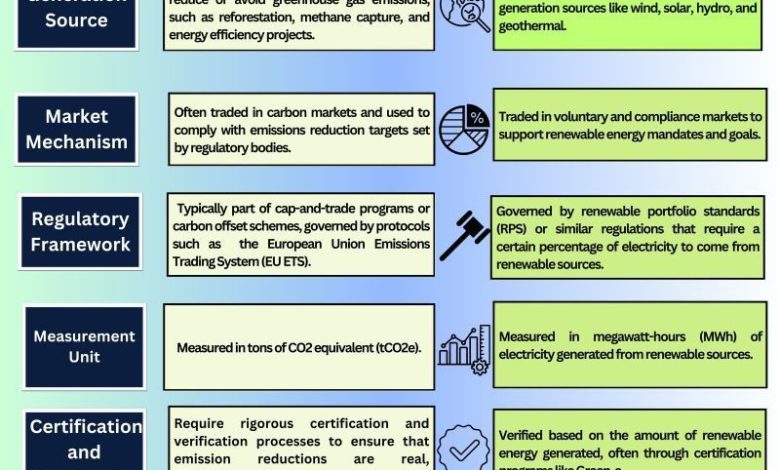
In the fight against climate change, Carbon Credits and Renewable Energy Certificates (RECs) serve as critical tools—but they are often misunderstood. While both aim to drive sustainability, their mechanisms, goals, and impacts are distinct. Let’s dive into these two pillars of climate action to understand their roles better.
What Are They?
- Carbon Credits: These are essentially permits that allow the holder to emit one ton of CO2 or equivalent greenhouse gases. By attaching a cost to emissions, Carbon Credits incentivize reductions.
- RECs: Renewable Energy Certificates signify that one megawatt-hour (MWh) of electricity was produced from renewable energy sources like solar, wind, or hydro. They certify the environmental benefits of clean energy production.
How Are They Generated?
- Carbon Credits: Derived from projects that prevent or remove emissions, such as reforestation, methane capture, or energy efficiency upgrades. These credits validate tangible greenhouse gas reductions or avoidance.
- RECs: Generated directly by renewable energy producers, certifying the environmental attributes of the electricity they produce and inject into the grid.
Why Are They Important?
- Carbon Credits: Vital for entities striving to meet emissions reduction targets, whether through voluntary commitments or regulatory requirements. They directly tackle greenhouse gas emissions.
- RECs: Critical in accelerating the global energy transition to renewables, supporting both compliance mandates and voluntary sustainability goals.
How Do They Work?
Both instruments have robust verification systems to ensure transparency and accountability:
- Carbon Credits focus on quantifying and verifying emission reductions through projects. Certification ensures the integrity of claimed offsets.
- RECs ensure that renewable energy was actually produced, with certification processes verifying the source and quantity of green energy generated.
The Impact
- Carbon Credits: Create a measurable, direct impact on greenhouse gas emissions by offsetting or reducing them.
- RECs: Indirectly reduce emissions by promoting renewable energy, which displaces fossil-fuel-based electricity generation.
Financial Incentives
- Carbon Credits: Offer financial returns to emission-reduction projects by allowing them to sell surplus credits in carbon markets. This makes green initiatives more economically attractive.
- RECs: Provide renewable energy producers with a revenue stream that makes clean energy generation more financially feasible.
Why Both Matter
While Carbon Credits focus on addressing the problem (reducing emissions), RECs work on building the solution (increasing renewable energy supply). Together, they form a complementary toolkit for combating climate change:
- Carbon Credits help decarbonize existing systems and neutralize unavoidable emissions.
- RECs drive the growth of a renewable energy economy, paving the way for a cleaner future.
Whether you’re shaping policy, running a business, or simply passionate about sustainability, understanding these mechanisms empowers you to take impactful action. Both tools serve the shared goal of creating a more sustainable planet—one ton of CO2 and one MWh at a time.
source :


