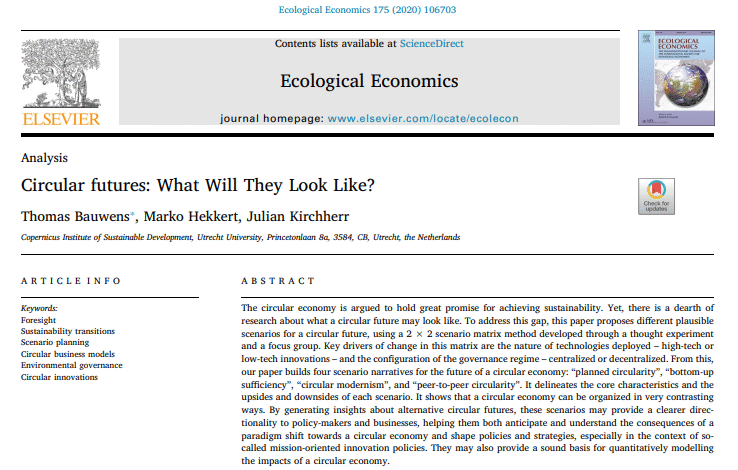
Circular futures: what will they look like?
The concept of circular economy (CE), which finds its roots in environmental and ecological economics, industrial ecology as well as management and corporate sustainability literature (e.g. Boulding, 1966; McDonough and Braungart, 2002; Pearce and Turner, 1990), is today hyped by policy-makers, academics and businesses as a concept to enable sustainable development (Geissdoerfer et al., 2017). A CE can be defined as “an economic system that is based on business models which replace the ‘end-of-life’ concept with reducing, alternatively reusing, recycling and recovering materials in production/distribution and consumption processes, thus operating at the micro level (products, companies, consumers), meso level (eco-industrial parks) and macro level (city, region, nation and beyond), with the aim to accomplish sustainable development, which implies creating environmental quality, economic prosperity and social equity, to the benefit of current and future generations” (Kirchherr et al., 2017, pp. 224–225). Major systemic transformations such as a transition to a CE call for a long-term vision and challenge current mindsets (Dufva et al., 2016). Firms, governments and other organizations need to anticipate future developments in order to prepare for them and the many barriers to be overcome (Kirchherr et al., 2018). While it is relatively easy to accommodate short term linear changes, longer term shifts in socio-technical systems and the impacts of technological disruptions are more difficult to cope with (Uotila et al., 2005).
Yet, despite the hype around CE, there is very little discussion around what a circular future may look like. As noted by Geissdoerfer et al. (2017, p. 766), the “[Time dimension] is excluded from “most [CE] discussions”. Only 1 of 114 CE definitions scrutinized in Kirchherr et al. (2017) discusses the time dimension and the impact of CE on future generations (Kirchherr et al., 2017, p. 228). Furthermore, as Weigend Rodríguez et al. (2019) argue, future studies and the CE literature are poorly integrated. Some practitioner studies have been published on the alleged economic, environmental and social impacts of CE, but their conceptual underpinning is limited (as further discussed in the next section). While insights about the potential impacts of a CE are important to accelerate the transition towards CE, a better understanding of the conceptual underpinning of a CE is a sine qua non for rigorously assessing its impacts. Indeed, we posit that a CE can be conceptualized in very different ways and that it is essential to better examine the trade-offs between these conceptual models and their societal consequences. Furthermore, many current approaches to CE adopt a micro perspective, focusing on a single firm or industry, and overlook the fundamental systemic changes needed to transition towards a CE.
To address these research gaps, this study aims to qualitatively conceptualize potential circular futures, providing a possible “true north”, particularly for policy-makers in their efforts to transition towards a more circular economy. Accordingly, the research question addressed is the following: What would a circular future look like? To do so, a thought experiment and a focus group are conducted to explore different plausible scenarios–scenarios “which ‘could happen’ (i.e. they are not excluded) according to our current knowledge (as opposed to future knowledge) of how things work” (Voros, 2003, p. 17)–for a circular future. These scenarios are not sector-specific, but are rather intended to outline the broad societal trends that may pervade multiple or all industrial sectors. The core upsides and downsides of each scenario and the potential trade-offs between them are described.
In terms of policy and business implications, these scenarios, by generating insights about alternative circular futures, may help policy-makers and businesses both anticipate and understand the consequences of a paradigm shift as well as support action in the present. They can provide a clearer directionality to shape policies and strategies for a transition towards CE. As such, they are particularly useful for the design of “mission-oriented innovation policies” (i.e. “systemic public policies that draw on frontier knowledge to attain specific goals”; Mazzucato, 2018; Wanzenböck et al., 2019) intended to accelerate the advent of a more circular economy.
The remainder of this article presents the methods adopted to address the above-mentioned research question (Section 2), the theoretical framing of this study (Section 3), the scenarios obtained (Section 4), their discussion (Section 5) and some concluding remarks (Section 6).
source:
https://www.sciencedirect.com/science/article/pii/S092180091931972X