ESG, CSR, Sustainability
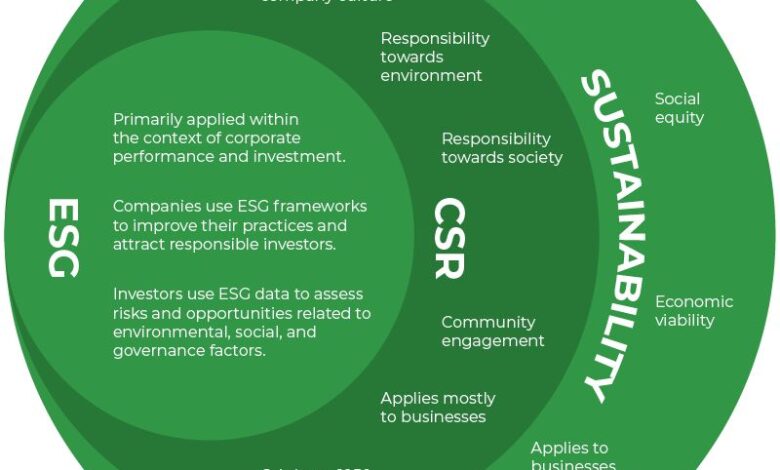
The concepts of sustainability, Corporate Social Responsibility (CSR), and Environmental, Social, and Governance (ESG) are often used interchangeably, but they represent distinct, though interconnected, ideas. Understanding the differences is crucial for businesses, investors, and individuals aiming to create a positive impact.
Sustainability: The Grand Vision
Sustainability is the overarching, long-term goal of balancing economic prosperity, social equity, and environmental protection. It’s a broad, all-encompassing concept that applies to everyone—governments, organizations, and individuals. Think of it as the ultimate destination: a world where we meet the needs of the present without compromising the ability of future generations to meet their own needs. It’s the vision for a thriving planet and society.
Historically, the idea can be traced back to the 17th-century German forestry term “nachhaltigkeit,” which emphasized managing resources so that future generations would have at least as much as the current one. The modern definition, however, was popularized in the 1987 Brundtland Commission Report, which officially defined it as “development that meets the needs of the present without compromising the ability of future generations to meet their own needs.”
CSR: The Corporate Conscience
Corporate Social Responsibility (CSR) is a business’s commitment to operate in an ethical and sustainable manner, contributing to economic development while improving the quality of life for its workforce, their families, and the local community and society at large. It’s about a company’s internal values and how they manifest in their actions. CSR is a voluntary effort and is often philanthropic in nature.
Examples include corporate donations to charities, employee volunteer programs, and fair labor practices. While CSR actions are often good for a company’s public image, they are not primarily driven by a desire for financial returns. The modern concept of CSR gained traction in the 1950s, with a focus on businesses’ responsibilities beyond just making a profit.
ESG: The Measurable Framework
Environmental, Social, and Governance (ESG) is a measurable framework that investors use to evaluate a company’s performance on sustainability and ethical issues. Unlike CSR, which is about a company’s responsibility, ESG is a set of data-driven criteria used to assess risk and opportunity. It’s the “how” of measuring a company’s commitment to sustainability and ethical practices from an investor’s perspective.
- Environmental (E): Looks at a company’s impact on nature. This includes carbon emissions, resource consumption, waste management, and renewable energy use.
- Social (S): Focuses on a company’s relationships with its employees, customers, suppliers, and the communities where it operates. This includes labor standards, diversity and inclusion, data privacy, and community relations.
- Governance (G): Examines a company’s leadership, internal controls, and shareholder rights. This includes executive compensation, board diversity and structure, and business ethics.
ESG provides a standardized way for investors to assess non-financial risks and identify companies that are better positioned for long-term success. It’s the investment lens that translates a company’s CSR and sustainability efforts into tangible metrics.
Summary: The Key Differences
To put it simply, think of it this way:
- Sustainability is the ultimate goal or vision for the world.
- CSR is a company’s philosophy and voluntary actions to achieve that vision.
- ESG is the metric or tool used by investors to measure a company’s progress toward that vision.
While CSR and ESG are often confused, their relationship is symbiotic. A company’s strong CSR practices like a commitment to fair wages or reduced carbon footprint will likely result in a positive ESG score. In essence, ESG is the “report card” that measures the effectiveness of a company’s CSR and overall sustainability efforts.
source: