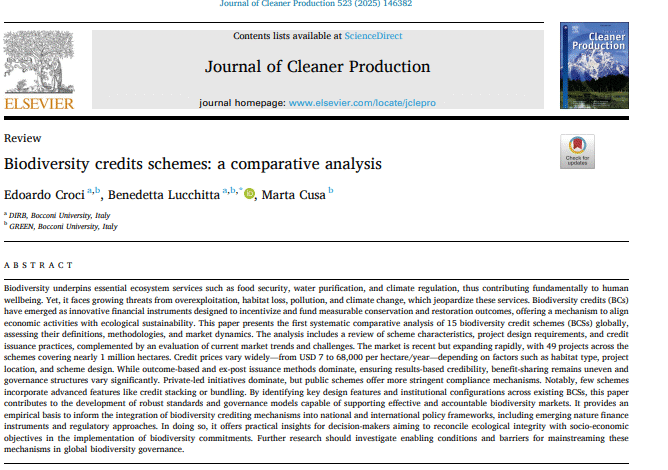
Biodiversity credits schemes: a comparative analysis
Biodiversity refers to the variety of living organisms originating from all sources, including terrestrial, marine, and other aquatic ecosystems, as well as the ecological complexes they form. It encompasses diversity at multiple levels: within species, between species, and across ecosystems (CBD, 1992). Biodiversity is a crucial component for natural capital and ecosystems stability allowing their regeneration and resilience to external disruptions (De Groot et al., 2003; EEA, 2015; Dasgupta, 2021;
Capitals Coalition, 2021). Functioning ecosystems are of pivotal importance for human wellbeing and socio-economic systems ensuring the flow of different goods and services, called ecosystem services – ES (Costanza et al., 2014; MA, 2005; Dasgupta, 2021). For instance, ES include provision services producing essential goods e.g. food, fuel, and clean water; cultural services including recreation and spiritual significance; as well as regulatory such as climate regulation, and natural hazard protection; and
supporting services like pollination or nutrient cycling (Folke et al., 2004; MA, 2005; Turner et al., 2007; IPBES, 2019). The status of biodiversity influences all categories of ES. For provisioning services,
diverse ecosystems provide a stable supply of essential resources, such as food, water, and raw materials. For example, agricultural systems with high plant diversity improve pollination and pest control, leading to increased yields and resilience against diseases (Isbell et al., 2011).
Similarly, fisheries with diverse species are more productive and resilient to environmental changes, ensuring sustainable fish stocks (Cardinale et al., 2012). For regulating services, biodiversity plays a
critical role in maintaining ecological processes. Functional diversity the range of different functional traits ensures that multiple species can perform similar roles, which enhances the stability and efficiency of processes such as nutrient cycling and carbon sequestration (Hooper et al., 2005). Diverse forest ecosystems can sequester more carbon, mitigating climate change impacts (Griscom et al., 2017; Seddon
et al., 2020; IPCC, 2022). Water purification and flood regulation are improved by increases in community diversity and the expansion of habitat areas (Harrison et al., 2014; Yao et al., 2017). Cultural services,
which encompass aesthetic, recreational, and spiritual values, are also influenced by biodiversity. Richly biodiverse landscapes offer unique recreational opportunities and support cultural identities (Diaz et al.,
2006; MA, 2005). The loss of biodiversity diminishes these cultural benefits, reducing both intrinsic and economic values. Lastly, biodiversity contributes to supporting services, such as soil formation and
nutrient cycling. Diverse species interactions promote decomposition and nutrient recycling, maintaining ecosystem productivity and resilience (Isbell et al., 2011; Hooper et al., 2005; Barbier, 2021).
source:
Temukan peta dengan kualitas terbaik untuk gambar peta indonesia lengkap dengan provinsi.