Kyoto protocol vs GHG protocol
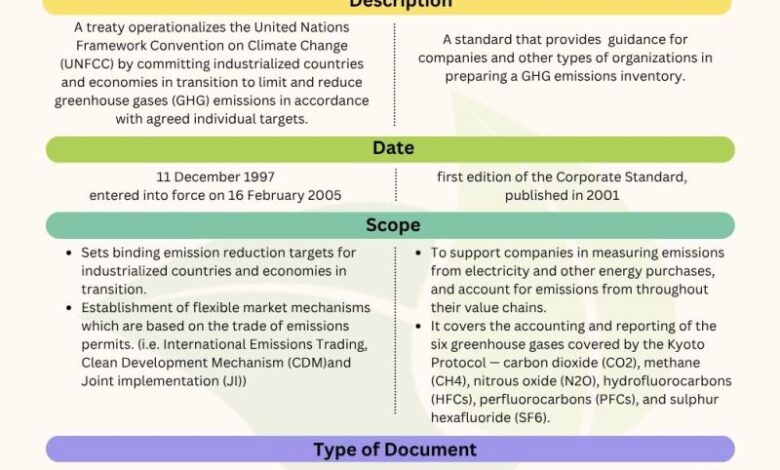
Clearing the Confusion: Kyoto Protocol vs. GHG Protocol
It’s completely understandable why many sustainability professionals confuse the Kyoto Protocol and the GHG Protocol. Both use the term “Protocol” and both center on Greenhouse Gas (GHG) reduction. However, they operate at fundamentally different levels of authority and applicability.
Think of it this way: one is a global law setting the direction, and the other is a corporate accounting book detailing how to measure the journey.
Kyoto Protocol: The Global Treaty
The Kyoto Protocol is a monumental, legally binding international treaty.
- Description: It was the predecessor that laid the essential framework for the current Paris Agreement. It established initial binding emission reduction targets for industrialized countries (Annex I Parties).
- Applicability & Scope: Its focus is entirely at the national level. Countries signed this treaty, committing their entire economies to specific emissions goals. It uses various mechanisms (like emissions trading and the Clean Development Mechanism) to help nations meet their commitments.
- Status: While it has largely been succeeded by the Paris Agreement, it remains historically crucial as the first major global commitment to climate action.
GHG Protocol: The Corporate Standard
The GHG Protocol is not a treaty but a global standardization tool for measuring, managing, and reporting greenhouse gas emissions.
- Description: It is the world’s most widely used accounting standard for quantifying GHG emissions. It provides a detailed, modular framework that companies use to understand their carbon footprint. Developed since the 1990s, it is regularly updated to reflect new challenges and best practices.
- Applicability & Scope: Its focus is on the organizational and project levels (corporations, cities, government agencies). Its primary contribution is defining the crucial Scopes for emission reporting:
- Scope 1: Direct emissions (e.g., from owned vehicles or facilities).
- Scope 2: Indirect emissions from purchased energy (e.g., electricity).
- Scope 3: All other indirect emissions across the value chain (e.g., purchased goods, business travel).
- Status: It is the de facto playbook that allows companies to transparently report their emissions, which then feeds into investor-driven frameworks like ESG and global goals like the SDGs.
In Summary: Law vs. Rulebook
| Feature | Kyoto Protocol | GHG Protocol |
| Type of Document | International, legally binding Treaty. | Voluntary, globally accepted Accounting Standard/Framework. |
| Applicability | Nations (National/Macro Level). | Organizations (Company/Micro Level). |
| Primary Function | Set binding targets for industrialized nations. | Provide rules and scopes for measuring and reporting emissions. |
| Focus | Climate Policy and collective global commitment. | Corporate Transparency and value chain measurement. |
To drive real impact, organizations need to understand both: they must follow the direction set by international agreements (like Kyoto’s successor, Paris) and use the precision provided by the GHG Protocol to accurately measure their contribution.
source: