
Sustainability acronyms you need to knows
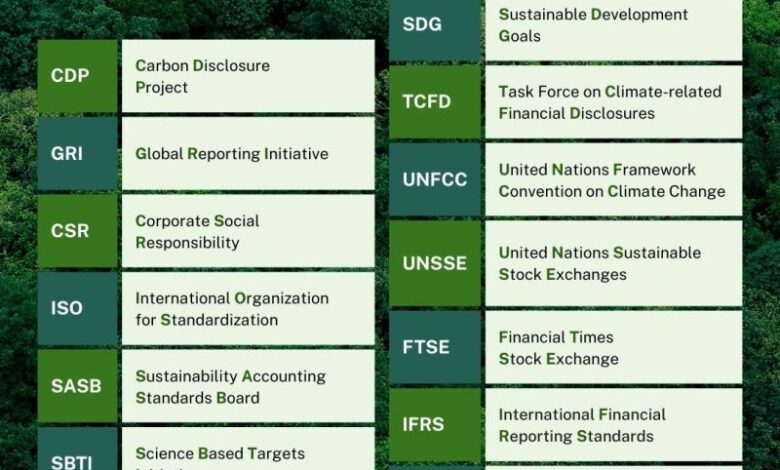
The ESG Lexicon: Decoding the Language of the Green Transition
In the world of corporate sustainability, acronyms are more than just industry jargon they represent the operating system of modern business accountability. To navigate this landscape, one must understand how these frameworks intersect to drive strategy, compliance, and climate action.
I. The Strategic Pillars: Defining “The What”
These acronyms define the broad scope of sustainability and the overarching goals for humanity.
- ESG (Environmental, Social, & Governance): The three central factors in measuring the sustainability and ethical impact of an investment in a company.
- SDG (Sustainable Development Goals): 17 global goals set by the UN to be achieved by 2030, serving as the “North Star” for societal progress.
- CSRD (Corporate Sustainability Reporting Directive): A major EU regulation that mandates companies to report on their environmental and social impact, introducing the concept of “Double Materiality.”
II. Climate Science & Strategy: Defining “The How”
These terms focus on the technical side of carbon accounting and setting scientifically-backed targets.
- GHG (Greenhouse Gas): The gases (like $CO_2$ and $CH_4$) responsible for the greenhouse effect. Accounting usually follows the GHG Protocol (Scope 1, 2, and 3).
- SBTi (Science Based Targets initiative): A partnership that provides companies with a clearly defined path to reduce emissions in line with the Paris Agreement goals.
- UNFCCC (UN Framework Convention on Climate Change): The international treaty that hosts the annual “COP” summits to coordinate global climate action.
III. Disclosure & Financial Risk: Defining “The Who”
These frameworks translate sustainability data into the language of investors and financial markets.
| Acronym | Focus Area | Why it Matters |
| TCFD | Climate-related Financial Disclosures | Focuses on the financial risk climate change poses to a company. |
| IFRS | Int. Financial Reporting Standards | Now integrating sustainability through the ISSB, merging financial and ESG data. |
| GRI | Global Reporting Initiative | The most widely used standard for reporting impact on the economy, environment, and people. |
IV. Operational & Trade Tools: Defining “The Impact”
These acronyms represent the “teeth” of sustainability regulations and standards that affect the supply chain and trade.
- CBAM (Carbon Border Adjustment Mechanism): A landmark EU tool that puts a fair price on the carbon emitted during the production of carbon-intensive goods entering the EU.
- EPR (Extended Producer Responsibility): A policy approach where producers are given a significant responsibility financial and/or physical for the treatment or disposal of post-consumer products.
- ISO (International Organization for Standardization): Provides world-class specifications (like ISO 14001 for Environmental Management) to ensure quality, safety, and efficiency.
Why Fluency Matters
The convergence of these standards (such as TCFD being absorbed into IFRS/ISSB) indicates that we are moving toward a Unified Global Baseline. Understanding these acronyms allows a professional to:
- Eliminate “Greenwashing”: By using precise, standardized terminology.
- Ensure Compliance: By staying ahead of mandatory directives like CSRD or CBAM.
- Drive Capital: By speaking the language that institutional investors use to assess risk.
The Verdict: Sustainability is no longer a “soft” skill; it is a data-driven discipline. Clarity in language leads to precision in action.
source:
Temukan peta dengan kualitas terbaik untuk gambar peta indonesia lengkap dengan provinsi.


