ESG vs CSR vs SDGs
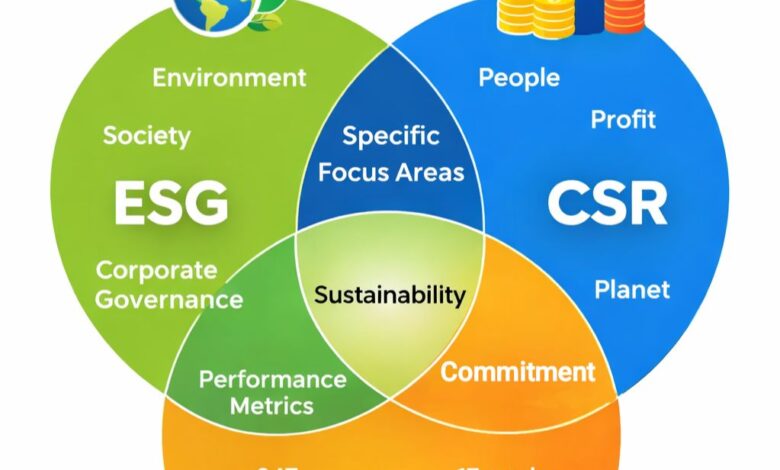
While these terms are often used as buzzwords in the corporate hallway, they represent distinct pillars of a modern, resilient business. To move from confusion to clarity, we must look at them through the lens of Intent, Framework, and Global Impact.
Here is the strategic breakdown of how these three concepts orchestrate a sustainable future.
The Sustainability Ecosystem: How ESG, CSR, and SDGs Interlock
To understand these terms, imagine a ship navigating the ocean: SDGs are the destination (The Map), CSR is the engine and crew’s effort (The Action), and ESG is the dashboard and sonar (The Data).
1. The Definitions: Beyond the Acronyms
CSR (Corporate Social Responsibility): The Moral Compass
CSR is a business model of self-regulation. It is internal and qualitative. It represents the “heart” of the company—how a business gives back to its community, treats its employees, and reduces its immediate footprint.
- Key Question: “What are we doing to be a good corporate citizen?”
- Nature: Qualitative, voluntary, and culture-driven.
ESG (Environmental, Social, Governance): The Investor’s Lens
ESG is a reporting framework used to evaluate a company’s resilience and risk profile. It transforms the “feel-good” initiatives of CSR into hard data that investors and regulators can verify.
- Key Question: “How does our sustainability performance impact our financial valuation and risk?”
- Nature: Quantitative, data-driven, and increasingly mandatory.
SDGs (Sustainable Development Goals): The Global Blueprint
Launched by the UN in 2015, the 17 SDGs are the universal North Star. They provide a common language for governments, NGOs, and businesses to tackle the world’s most pressing challenges from “Zero Hunger” to “Climate Action.”
- Key Question: “How does our business contribute to solving the world’s 17 biggest problems by 2030?”
- Nature: Global, aspirational, and collaborative.
2. The Relationship: How They Work Together
Sustainability isn’t a choice between these three; it’s a progression.
| Concept | Functional Role | Strategic Outcome |
| SDGs | Goal Setting | Defines the “Why” and the “Where” (Global Direction). |
| CSR | Operational Execution | Defines the “How” (Internal Actions & Initiatives). |
| ESG | Performance Tracking | Defines the “Results” (Data, Metrics, & Transparency). |
3. The Integration Strategy
When a company aligns these three, they create a Credibility Loop:
- Alignment: A company identifies which SDGs align with its core business (e.g., a tech company focuses on SDG 4: Quality Education).
- Activation: The company launches a CSR program (e.g., providing free coding boot camps for underprivileged youth).
- Accountability: The company tracks the success of that program using ESG metrics (e.g., measuring the “S” or Social factor through the number of jobs secured and diversity ratios), then reports this to investors.
- CSR is about Philanthropy and Culture.
- ESG is about Risk and Performance.
- SDGs are about Global Impact.
In 2026, companies that only do “CSR” are seen as philanthropic; those that do “ESG” are seen as professional; but those that align with “SDGs” are seen as visionary.