Carbon vocabulary essential terms you need to knows
The Executive Carbon Lexicon: Strategic Intelligence for a Decarbonized Economy
Fluency in carbon terminology is no longer a “green” nice it is a core requirement for modern fiduciary duty. In an era of mandatory disclosures and carbon pricing, these terms represent the difference between a resilient business model and a stranded asset.
I. Emission Scopes: Mapping Your Risk Exposure
The GHG Protocol divides emissions into three “Scopes” to help organizations visualize where their climate impact and financial risk truly lies.
- Scope 1: Direct Emissions. Greenhouse gases released from sources owned or controlled by your company (e.g., your vehicle fleet or onsite furnaces).
- Scope 2: Indirect (Purchased) Emissions. Emissions from the generation of electricity, steam, heating, or cooling purchased by your organization.
- Scope 3: Value Chain Emissions. Often the largest category (up to 90% of a company’s footprint), these are emissions that occur in the value chain, including both upstream (suppliers) and downstream (product use and disposal).
II. Strategic Targets: Defining the Goalpost
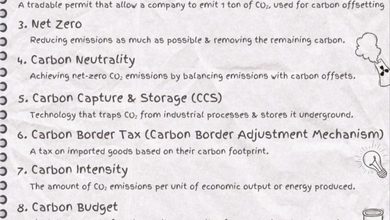
Understanding the nuance between “Net-Zero” and “Carbon Neutral” is the primary defense against greenwashing allegations.
| Term | Definition | Strategic Nuance |
| Carbon Neutral | Balancing carbon emissions with an equivalent amount of carbon offsets. | Allows for ongoing emissions as long as they are “offset” elsewhere. |
| Net-Zero | Reducing emissions to the absolute minimum and neutralizing only “residual” emissions with permanent removal. | Focuses on deep decarbonization (usually >90% reduction) before relying on offsets. |
| Science-Based Targets (SBTi) | Emission reduction targets aligned with what the latest climate science deems necessary to meet the Paris Agreement goals. | Moving from “doing our best” to “doing what is scientifically required.” |
III. Market Mechanisms: Putting a Price on Carbon
Carbon is shifting from a “free externality” to a line item in the balance sheet.
- Carbon Credit: A tradable permit representing the right to emit one tonne of CO2. These are generated by projects that reduce or remove emissions.
- Internal Carbon Pricing (ICP): A voluntary monetary value a company places on its own carbon emissions to guide investment decisions and incentivize low-carbon innovation.
- Carbon Capture, Utilization, and Storage (CCUS): A suite of technologies that capture CO2 at the source or from the air to either store it underground or use it in industrial processes.
IV. Lifecycle Impact: Seeing the Full Picture
To innovate, leaders must look beyond the factory gate.
- Embodied Carbon: The total greenhouse gas emissions generated during the extraction, manufacture, and transportation of building materials or products before they are even used.
- Carbon Intensity: The amount of carbon emitted per unit of output (e.g., CO2 per dollar of revenue or per tonne of product). This is the key metric for measuring efficiency rather than just total volume.
V. The “Carbon Strategy” Strike Team
Navigating this vocabulary requires cross-functional coordination. Fluency must exist across the C-Suite:
- CFO: To manage Internal Carbon Pricing and transition risk.
- CSO: To ensure Science-Based Targets are technically viable.
- COO: To mitigate Scope 3 risks within the supply chain.
- CLO: To ensure Net-Zero claims meet the highest regulatory scrutiny.
In the carbon economy, ambiguity is a liability. By mastering these terms, organizations shift from a defensive posture of “compliance” to a proactive strategy of “competitive decarbonization.”
source: