Sustainable development matrix
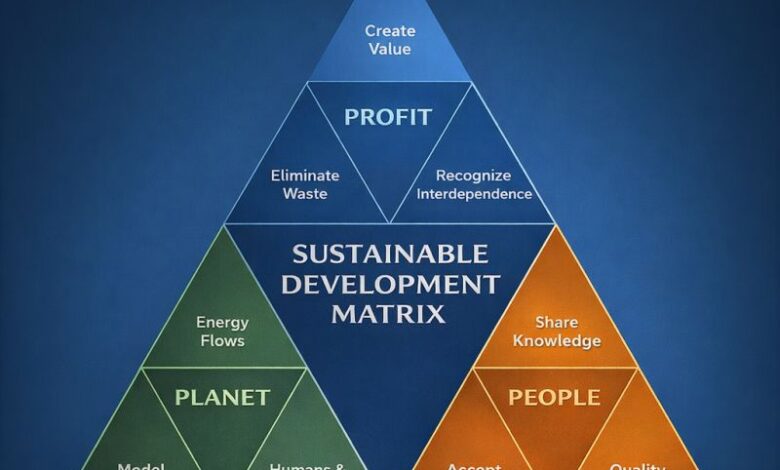
The Sustainable Development Matrix: Why Balance is the New Bottom Line
Sustainability is often diluted into a marketing tagline, but in the harsh reality of the 21st-century economy, it is a high-stakes operating system. True progress is not found in choosing between the earth and the economy; it is found in the Sustainable Development Matrix where Planet, People, and Profit function as a single, interlocking machine.
When one pillar is prioritized at the expense of others, the system doesn’t just lean it collapses.
1. Planet: The Non-Negotiable Foundation
Nature is not an “externality” to be managed; it is the ultimate landlord. Every supply chain, energy grid, and city block sits atop a biological foundation.
- The Shift: Moving from “extracting resources” to “respecting flows.”
- The Reality: Designing human activity to coexist with the environment isn’t just “being green” it is ensuring the raw materials of your business exist ten years from now.
2. People: The Engine of Legitimacy
Policies do not change the world; people do. A green transition that leaves communities behind or exploits its workforce is a house of cards.
- The Shift: Moving from “participation” to “empowerment.”
- The Reality: When employees and communities are stakeholders in the transition, sustainability moves from a corporate directive to an everyday habit. Equity is the fuel for long-term productivity.
3. Profit: The Catalyst for Scale
Profit is the lifeblood that allows a sustainable idea to become a global standard. However, the definition of profit is evolving from “quarterly gains” to “durable value.”
- The Shift: Moving from “short-term exploitation” to “interdependent growth.”
- The Reality: A business that reduces waste and secures its supply chain is inherently more competitive. Profit provides the capital necessary to scale planet-saving technologies from the lab to the landscape.
The Matrix: Solving for Interdependence
The power of the Matrix lies in the “Gaps” the catastrophic failures that occur when we work in silos:
| The Missing Pillar | The Resulting Crisis | The Impact |
| Planet (-) Profit | Stagnation | Solutions remain “pilot projects” because they lack the financial engine to scale. |
| Profit (-) People | Instability | Systems lose their social license to operate, leading to strikes, boycotts, and unrest. |
| People (-) Planet | Extinction | Society prospers in the short term but destroys the very air, water, and soil required for a future. |
Moving from Silos to Systems
Sustainability is not a department or a glossy PDF report; it is a decision-making framework. It forces a simple but radical question into every boardroom and kitchen table: “Does this choice strengthen all three pillars, or does it create a trade-off that will haunt us later?”
The bottom line:
- Economic growth without social equity fails.
- Environmental protection without economic viability stalls.
- Social progress without a healthy planet ends.
The future belongs to the architects of balance. Designing for systems, not silos, is the only way to build a business that is resilient, a community that is thriving, and a planet that is healthy.
source: