
What makes up Microplastic?
The Invisible Ghost: Why We Are Living in a Plastic Shell
We used to think of plastic pollution as a distant problem a stray bottle on a beach or a bag tangled in a turtle’s path. But the reality is much closer to home. We are living in a “plastic rain” of our own making.
Microplastics (particles smaller than 5mm) aren’t just waste; they are the unintended byproduct of modern convenience. They are the microscopic debris of a world built on synthetics.
1. The Fiber in Your Fabric
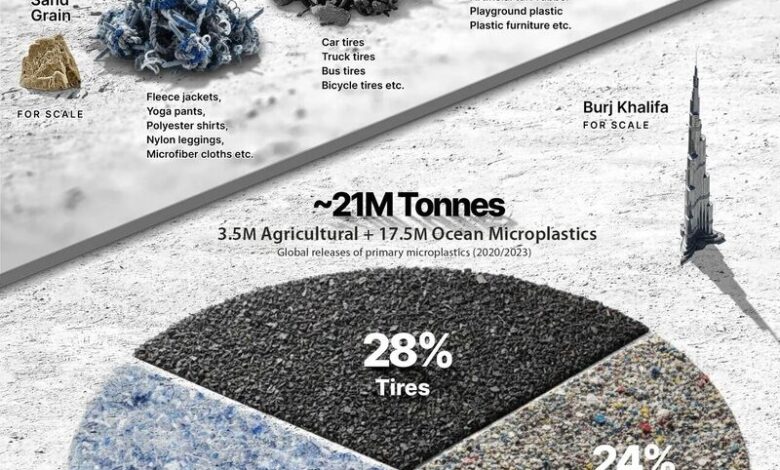
Every time you run a load of laundry, your favorite yoga pants or fleece jacket are subtly dissolving. Synthetic textiles polyester, nylon, and acrylic are responsible for a staggering 35% of global microplastic leakage.
As these fabrics agitate in the wash, they shed millions of microscopic plastic threads. Too small for most municipal filters to catch, these fibers travel from your washing machine straight into the bellies of aquatic life, and eventually, back onto our dinner plates.
2. The Dust of the Road
Every time a car brakes or rounds a corner, it leaves a trace behind. Tire wear accounts for 28% of the microplastics in our environment. While we call it “rubber,” modern tires are a complex blend of synthetic polymers.
As we drive, friction grinds these tires into a fine plastic dust that settles on roads, only to be swept into our rivers and lungs by the next rainstorm or gust of wind.
3. The Anatomy of City Dust
Our urban environments are essentially shedding. About 24% of microplastic pollution comes from “city dust”—the slow erosion of the world around us:
- The soles of our shoes wearing down on the pavement.
- The weathering of artificial turf on sports fields.
- The degradation of outdoor plastic furniture and playground equipment.
The Scale of the “Invisible”
It is estimated that 21 million tonnes of these primary microplastics enter our ecosystems every year. Unlike a plastic bottle, which can be picked up, these particles are nearly impossible to recover once they are released. They have become a permanent part of the Earth’s geological record.
| Source | Contribution | Common Culprit |
| Synthetic Textiles | 35% | Fleece, Polyester, Spandex |
| Tires | 28% | Car and Truck tire erosion |
| City Dust | 24% | Shoe soles, artificial turf, paints |
| Road Markings | 7% | Highway paint and thermoplastic lines |
| Personal Care/Other | 6% | “Microbeads” in scrubs and industrial pellets |
Redesigning the Future: The Circular Exit
If we cannot clean up microplastics, we must stop them at the source. This requires a fundamental shift in how we build our world:
- Filtered Fashion: Developing washing machine filters that catch 99% of microfibers before they reach the drain.
- Bio-Based Polymers: Moving away from petroleum-based synthetics toward materials that truly biodegrade in natural environments.
- Urban Filtration: Designing “Sponge Cities” (as discussed in climate resilience) that use specialized soil and plant layers to trap road dust before it hits the water table.
The microplastic crisis is a design flaw. By rethinking the materials that touch our skin and carry us to work, we can stop the invisible leak and ensure that the “plastic age” doesn’t become our permanent legacy.


