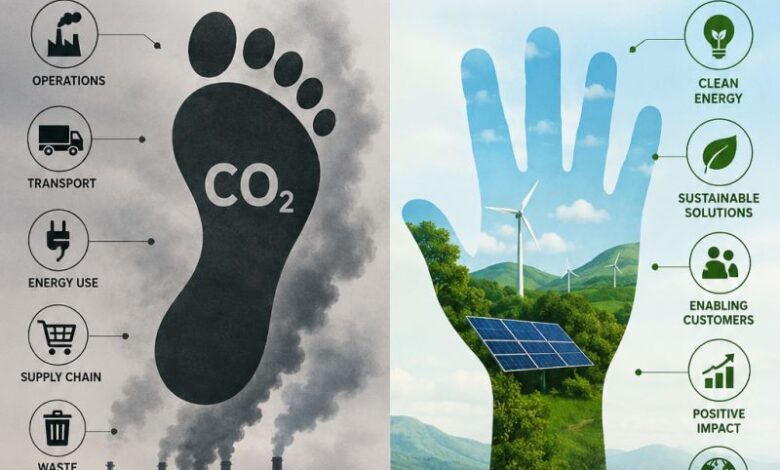
Carbon footprint vs carbon handprint
Why Forward-Thinking Leaders Are Measuring Their “Carbon Handprint”
For years, corporate climate strategy has been a game of defense. Organizations have poured immense resources into measuring and mitigating their carbon footprint accounting for every gram of greenhouse gas emitted across operations, supply chains, and logistics.
This is non-negotiable. Shrinking our negative impact is the baseline of climate responsibility.
But playing defense only gets you to zero. To drive true climate transformation, forward-thinking organizations are switching to offense. They are measuring a powerful, forward-looking metric: the carbon handprint.
The Core Shift: Defense vs. Offense
The distinction between the two metrics changes the entire narrative of corporate sustainability from a burden to an innovation driver:
| Metric | The Core Question | The Strategic Goal | Focus |
| Carbon Footprint | “How much harm do we cause?” | Minimize negative impact | Internal Operations |
| Carbon Handprint | “How much good do we enable?” | Maximize positive impact | Market Enablement |
Consider a manufacturer of industrial smart-thermostats. Their footprint includes the energy used in their factories and the logistics of shipping products. But their handprint is the massive, exponential reduction in energy consumption achieved by the thousands of buildings using their technology.
Why Measuring Both is a Competitive Superpower
When organizations expand their view to include the handprint, sustainability stops being treated purely as a compliance cost and starts being viewed as a revenue driver.
- It Recommends Innovation: Instead of just asking “How do we make this process less bad?”, teams begin asking, “What can we design that solves our customers’ climate liabilities?”
- It Changes the Brand Narrative: Consumers, investors, and talent are fatigued by standard “net-zero” promises. Showcasing a tangible, verifiable carbon handprint demonstrates active market leadership.
- It Amplifies Collective Impact: A single company’s footprint reduction is capped at its own operations. Its handprint capacity is theoretically limitless, scaling with every customer it adopts.
The Golden Rule of Climate Metrics: The handprint is never an excuse for a heavy footprint. You cannot offset operational negligence with external good. The goal is to aggressively shrink the footprint while exponentially scaling the handprint.
The Next Steps for Leadership
If your organization is ready to move beyond basic footprint tracking, start by auditing your portfolio through a handprint lens. Look at your products, services, or software and ask: Does this help our clients use less energy, reduce waste, or transition away from fossil fuels?
If the answer is yes, you have a handprint. It’s time to start measuring it, scaling it, and treating it as your most valuable product feature.
source: