Tahukah Anda
How urban planning impacts people’s lives
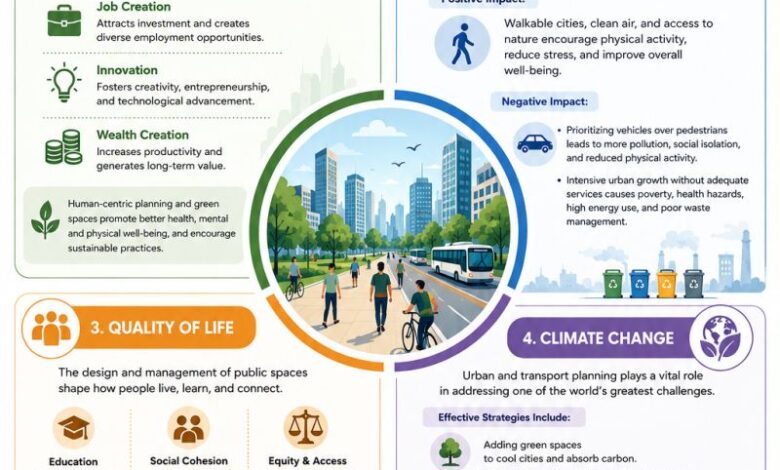
4 Core Pillars of Urban Impact
1. Economic & Social Mobility
- Agglomeration & Innovation: High-density, mixed-use zoning concentrates talent and capital, lowering logistical costs for businesses and accelerating knowledge sharing.
- Human-Centric Prosperity: Shift from single-use industrial grids to walkable, mixed-use corridors attracts talent and fosters vibrant commercial hubs.
- Equal Opportunity Access: Transit-oriented development (TOD) ensures lower-income communities can reliably reach employment centers without the financial burden of car ownership.
2. Physical & Psychological Health
- Active Design vs. Sedentary Sprawl: Car-centric layouts increase traffic emissions and reduce daily physical activity. Walkable neighborhoods with wide sidewalks, bike lanes, and pocket parks naturally integrate exercise into daily routines.
- Environmental Hazards: Unchecked urban growth without proper waste management and drainage creates localized pollution hotspots and exacerbates health disparities in dense, low-income zones.
- Mental Well-being: Access to green spaces directly lowers cortisol levels and combats the social isolation caused by auto-dominated suburban sprawl.
3. Public Space & Social Cohesion
- Equity in Infrastructure: Shared civic spaces plazas, libraries, and public parks act as social equalizers where diverse demographics interact freely.
- Safety & Security: Urban layouts incorporating Jane Jacobs’ concept of “eyes on the street” (active ground-floor retail, visible walkways) enhance community self-policing and public safety.
4. Climate Resilience & Environmental Sustainability
- Urban Heat Island Mitigation: Urban canopies and permeable surfaces lower localized temperatures, countering heat retentive concrete and asphalt.
- Carbon Reduction: Prioritizing pedestrian networks and electrified mass transit over private vehicle infrastructure reduces municipal greenhouse gas emissions.
Comparing Urban Design Models
| Dimension | Car-Centric Sprawl | Human-Centric / Walkable City |
| Primary Transit Mode | Private Motor Vehicles | Active Transit (Walking, Cycling, Mass Transit) |
| Zoning Strategy | Single-use (Distanced residential & commercial) | Mixed-use (Retail, residential & office integrated) |
| Health Impact | Higher rates of physical inactivity & respiratory risks | Higher daily physical activity & lower stress markers |
| Climate Resilience | High emissions, high runoff, urban heat traps | Green infrastructure, lower carbon footprint, flood mitigation |
Urban planning determines how efficiently a city functions and how equitably its opportunities are distributed. Designing cities around human needs rather than vehicle throughput creates resilient, sustainable environments where communities thrive.
source: