Tahukah Anda
Introduction to ESG
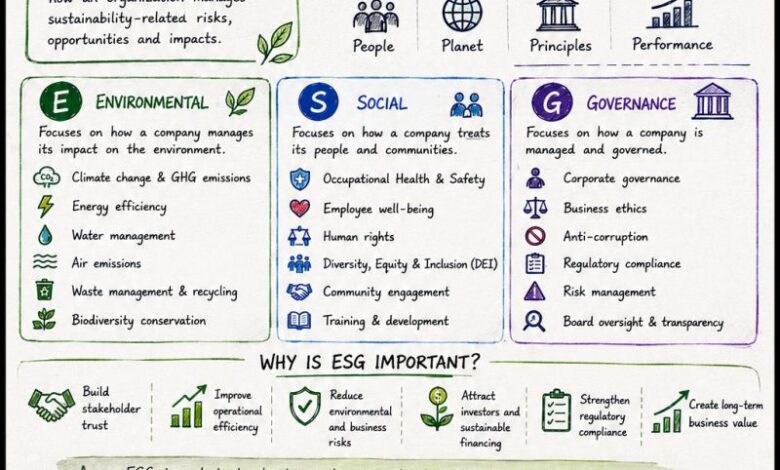
Environmental, Social, and Governance (ESG) represents a strategic framework used by investors, lenders, and corporate leaders to evaluate an organization’s operational sustainability, ethical risk exposure, and long-term financial viability.
Unlike traditional business metrics that focus exclusively on short-term balance sheets, ESG integrates non-financial risk factors into core strategic decision-making.
1. The 3 Core Pillars of ESG
- Environmental (E): Measures how a company impacts and is impacted by the natural ecosystem. Key areas include greenhouse gas (GHG) emissions, energy efficiency, water stewardship, waste management, and biodiversity protection.
- Social (S): Evaluates how an organization manages its relationships with internal workforce and external communities. Key areas include health and safety standards, labor practices, human rights due diligence, diversity, equity, and inclusion (DEI), and customer data protection.
- Governance (G): Focuses on internal oversight, decision-making structures, and corporate ethics. Key areas include board independence, anti-corruption policies, executive compensation alignment, enterprise risk management (ERM), and shareholder rights.
2. Terminology Demystified: ESG vs. CSR vs. Sustainability
While frequently used interchangeably, these terms represent distinct approaches to corporate responsibility:
| Feature / Dimension | Corporate Social Responsibility (CSR) | Corporate Sustainability | ESG (Environmental, Social, Governance) |
| Primary Driver | Ethical motivation & brand reputation | Resource stewardship & operational longevity | Financial risk mitigation & capital allocation |
| Target Audience | General public & local communities | Internal operations & broader society | Institutional investors, regulators & lenders |
| Measurement Approach | Qualitative, narrative, and philanthropic | Broad ecological & socio-economic metrics | Quantitative, standardized, and externally assured |
| Integration Level | Peripheral (often philanthropic projects) | Operational (embedded in resource management) | Core Strategy (embedded in ERM & governance) |
3. How ESG Unlocks Long-Term Enterprise Value
[Risk Reduction & Compliance]  ──> Prevents Fines & Supply Chain Disruptions ──┐
[Resource Efficiency]          ──> Reduces Energy, Water, & Material Costs   ──┼──> Enterprise Value Expansion
[Capital & Investor Access]    ──> Lowers Cost of Capital & Debt Financing   ──┤    & Brand Equity
[Market & Customer Growth]     ──> Captures Sustainable Consumer Demand       ──┘
- Cost Reduction: Waste minimization and energy efficiency directly reduce operational overhead (OPEX).
- Capital Access: ESG-compliant organizations gain easier access to green bonds, sustainability-linked loans, and institutional investment portfolios.
- Risk Mitigation: Proactive alignment with regulatory trends prevents costly legal disputes, compliance penalties, and stranded asset risks.
20-Part ESG Fundamentals Series Roadmap
- Part 1: Introduction to ESG: Foundations & Value Creation
- Part 2: History & Evolution of ESG: From SRI to Mainstream Finance (Next Up)
- Part 3–5: Deep Dive: Environmental (E) Pillars & GHG Accounting
- Part 6–8: Deep Dive: Social (S) Frameworks & Supply Chain Audits
- Part 9–11: Deep Dive: Governance (G) & Board Level Oversight
- Part 12–20: Integration, Frameworks (GRI, ISSB, CSRD), & Strategy Execution
source: