Does sustainability really equal ESG?
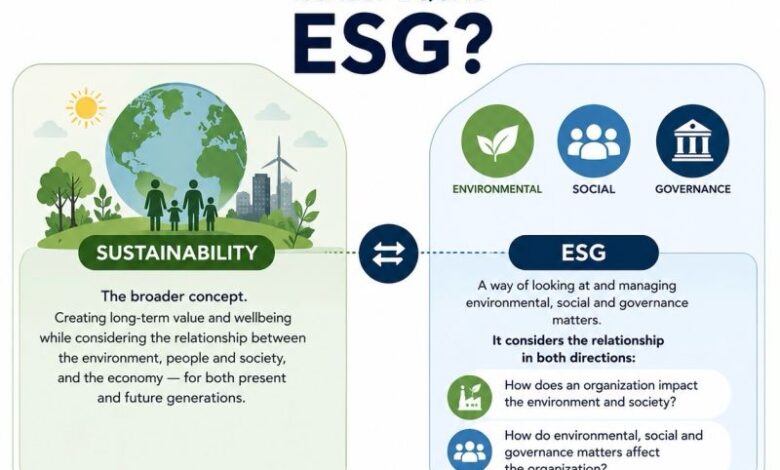
While “Sustainability” and “ESG” are frequently used interchangeably in corporate boardrooms and marketing collateral, they represent distinct concepts with different origins, audiences, and operational goals. Confusing the two can lead to strategic misalignments, regulatory non-compliance, or accusations of greenwashing.
Core Distinctions: Sustainability vs. ESG
           SUSTAINABILITY                              ESG
  ┌──────────────────────────────┐          ┌──────────────────────────────┐
  │ • Vision & Ethos             │          │ • Tool & Framework           │
  │ • Broad & Qualitative        │   VS     │ • Quantitative & Metrics     │
  │ • All Stakeholders           │          │ • Investors & Regulators     │
  │ • Planet & Society Centric   │          │ • Corporate Risk & Value     │
  └──────────────────────────────┘          └──────────────────────────────┘
| Dimension | Sustainability | ESG (Environmental, Social, Governance) |
| Primary Focus | The long-term health and viability of planetary and human systems. | Measuring corporate exposure to ESG risks and operational impacts. |
| Key Audience | Society at large, local communities, future generations, employees. | Capital markets, investors, credit rating agencies, regulators. |
| Operational Goal | Operating within planetary boundaries and promoting equitable growth. | Enhancing corporate governance, mitigating risk, and proving financial resilience. |
| Origin & Context | Philosophical, ecological, and policy frameworks (e.g., UN SDGs). | Capital market frameworks designed for valuation and risk management. |
The Two-Way Street: Double Materiality
The relationship between a company and its surrounding environment operates in two distinct directions. In modern corporate reporting, this dynamic is formalized as Double Materiality:
- Inside-Out Impact (Impact Materiality): How the company’s operations, supply chains, and products affect people and the natural environment (e.g., carbon emissions, water extraction, labor practices). This is the core domain of traditional Sustainability.
- Outside-In Impact (Financial Materiality): How external environmental and social changes create financial risks or opportunities for the company (e.g., climate physical risks damaging facilities, regulatory penalties, resource scarcity). This is the primary domain of ESG.
Sustainability defines the ultimate end goal a balanced system where society and economy thrive within ecological limits. ESG provides the data, governance structures, and reporting metrics used by capital markets to hold businesses accountable to that goal.
Why the Distinction Matters for Strategy
Confusing these two concepts creates strategic blind spots:
- Treating ESG as a Compliance Box-Checking Exercise: Concentrating solely on ESG metrics can lead to high rating scores without actually reducing real-world ecological impact or driving sustainable innovation.
- Pursuing Sustainability Without Governance: Committing to ambitious sustainability targets (e.g., Net Zero by 2050) without robust ESG governance and disclosure metrics often results in missed targets and reputational backlash.
source: