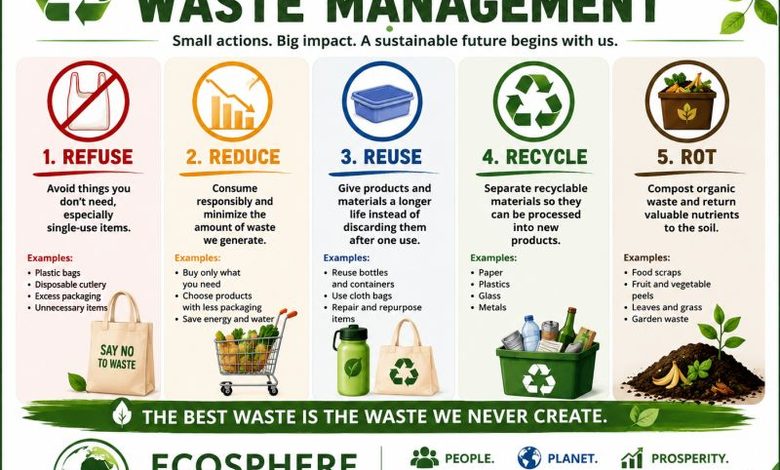
The 5Rs of waste management
Rethinking What We Consume Before It Becomes Waste
Waste management does not begin when we throw something into a bin.
It begins much earlier with the choices we make before we buy, use, and eventually discard something.
Every product we consume requires resources: raw materials, water, energy, land, transportation, and human effort. When that product becomes waste after a short period of use, all those resources are effectively tied to something we no longer want.
That is why responsible waste management is not only about how we dispose of waste.
It is about asking a more fundamental question:
Can we prevent that waste from being created in the first place?
One simple framework can help us rethink our relationship with consumption: the 5Rs of Waste Management.
1. REFUSE — Say No Before Waste Exists
The most effective way to manage waste is often to avoid creating it in the first place.
Refuse products and services you do not actually need, particularly unnecessary single-use items.
Do you need another plastic bag?
Do you need disposable cutlery when reusable alternatives are available?
Do you need promotional items that will likely be forgotten after a few days?
Every unnecessary item we refuse represents waste that never needs to be produced, transported, processed, or disposed of.
Refusing is prevention at the source.
2. REDUCE — Consume Less, Consume Better
We live in a system that often encourages us to buy more, replace faster, and consume continuously.
The Reduce principle challenges that mindset.
Buy only what you need. Choose durable products. Avoid excessive packaging. Consider quality and longevity rather than simply price or convenience.
Reducing consumption also means reducing the environmental footprint associated with producing the things we buy.
Less unnecessary consumption means less resource extraction, less energy use, and less waste.
3. REUSE — Give Things a Second Life
Before throwing something away, ask:
“Can I use this again?”
A reusable bottle can replace hundreds of disposable ones.
A shopping bag can be used repeatedly.
Furniture can be repaired rather than replaced.
Containers can be repurposed.
Clothing can be donated, repaired, or transformed into something new.
Reuse extends the useful life of products and delays their journey toward becoming waste.
It also challenges the idea that something loses its value simply because we have finished using it.
Sometimes, the most sustainable product is the one we already own.
4. RECYCLE — Return Materials to the Economy
Not everything can be refused, reduced, or reused.
That is where recycling comes in.
Materials such as paper, cardboard, metals, glass, and certain plastics can potentially be collected, processed, and transformed into new products.
But recycling only works effectively when materials are properly separated and kept as clean as possible.
This means recycling is not simply about putting something into a recycling bin.
It requires a system involving:
Households → Collection → Sorting → Processing → Industry → New Products
The stronger this chain becomes, the more materials can remain in circulation rather than ending up in landfills or leaking into the environment.
5. ROT — Return Organic Matter to the Soil
What about food scraps, leaves, and other organic materials?
Instead of sending them to landfill, they can potentially be composted.
The principle is simple:
Organic waste → Decomposition → Compost → Soil nutrients → New growth
Composting returns valuable organic matter to the soil while reducing the amount of biodegradable waste entering the disposal system.
For households, communities, schools, businesses, and cities, composting can become a practical way to close part of the biological loop.
The 5Rs Are More Than a Waste Hierarchy
The real power of the 5Rs is that they encourage us to move upstream.
Traditional waste management often focuses on what happens after something becomes waste:
Collect → Transport → Process → Dispose
The 5Rs ask us to intervene much earlier:
Refuse → Reduce → Reuse → Recycle → Rot
This changes the conversation from:
“How do we manage all this waste?”
to:
“Why are we creating so much waste in the first place?”
That is a much more transformative question.
From Individual Habits to Collective Change
Of course, individual action alone cannot solve the global waste crisis.
Consumers need access to better products and services.
Businesses need to redesign products and packaging.
Governments need effective policies and infrastructure.
Communities need systems that make sustainable choices practical and affordable.
Industries need to create markets for recycled and recovered materials.
In other words, the 5Rs work best when individual responsibility is supported by systemic change.
At EcoSphere Sustainable Development Initiative (ESDI), we believe sustainable waste management requires more than cleaning up waste after it has been generated.
It requires awareness, responsible consumption, community participation, innovation, supportive systems, and practical action.
source:
https://lnkd.in/p/gbNxgF9n