Every choice shapes our planet small choices, big impact
Rethinking the Modern Waste Hierarchy
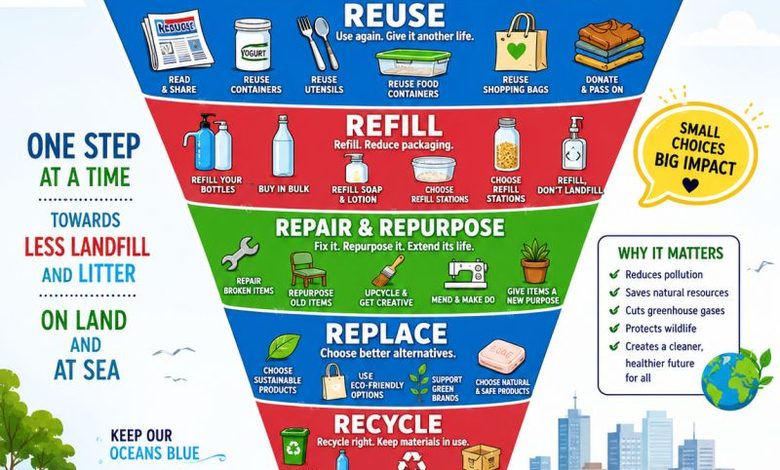
True sustainability is rarely about achieving absolute perfection; it is driven by systemic, incremental shifts in everyday decision-making. While traditional environmental campaigns often reduced waste management to a simple three-step model Reduce, Reuse, Recycle modern material science and circular economy principles require a more granular, actionable framework.
The Modern 7-Tier Waste Hierarchy
To minimize material throughput and maximize energy efficiency, consumption decisions should be evaluated through a prioritized seven-tier framework. The higher a strategy sits on the hierarchy, the more energy, labor, and raw materials it preserves.
                  THE CIRCULAR ACTION HIERARCHY

   [ HIGHEST VALUE ]  ♻️  REDUCE             (Prevent virgin throughput)
                      🔄  REUSE              (Preserve initial product state)
                      💧  REFILL             (Eliminate single-use packaging)
                      🛠️  REPAIR / REPURPOSE (Extend material utility)
                      🌱  REPLACE            (Shift to renewable inputs)
                      ♻️  RECYCLE            (Recover raw material value)
   [ LOWEST VALUE ]   🗑️  DISPOSE RESPONSIBLY(Contain non-recoverable waste)
Technical & Systemic Impact Breakdown
Each tier in the hierarchy represents a different level of energy retention and environmental intervention:
| Tier | Primary Objective | Systemic Environmental Benefit |
| 1. Reduce | Eliminate unnecessary consumption and virgin resource extraction. | Reduces upstream Scope 1 and Scope 3 emissions; prevents initial ecosystem disruption. |
| 2. Reuse | Keep products in their functional state without re-manufacturing. | Bypasses energy-intensive processing; maximizes the embodied carbon of manufactured goods. |
| 3. Refill | Standardize reusable container infrastructure. | Drastically cuts single-use plastics and packaging waste in municipal streams. |
| 4. Repair & Repurpose | Restore functionality or convert products for new functional uses. | Diverts complex manufactured items (e.g., electronics, textiles) from early landfilling. |
| 5. Replace | Transition to bio-based, non-toxic, or sustainably sourced inputs. | Reduces reliance on petrochemical synthetics and persistent environmental pollutants. |
| 6. Recycle | Downcycle or re-process materials into raw feeds. | Preserves base materials (e.g., metals, glass, PET), though requires energy for processing. |
| 7. Dispose Responsibly | Safely isolate non-recyclable materials in managed facilities. | Prevents hazardous leaching, microplastic shedding, and unmanaged fugitive emissions. |
Moving Toward a Circular Economy
The fundamental premise of circular economics is that waste is a design flaw. When consumer habits, industrial manufacturing, and policy mechanisms align with higher-tier actions such as designing for repairability (Right to Repair) and establishing closed-loop refill logistics the demand for continuous extraction drops.
Every micro-decision across supply chains and households acts as a voting mechanism for the type of infrastructure society builds. Progress toward planetary health relies on scaling these deliberate choices across millions of daily interactions.
source:
https://lnkd.in/p/etCra2Vf