Local Planners and Global Goals: Accepted but not Absorbed
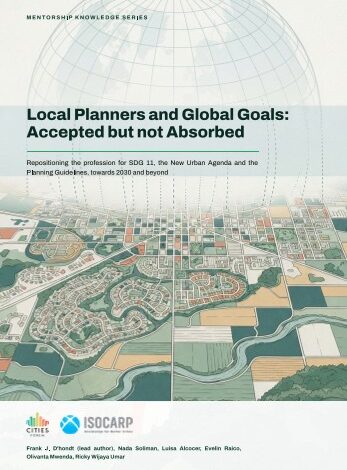
New Publication | Cities Forum Mentorship Knowledge Series
We are pleased to share a new publication from the CITIES FORUM in colloboration with ISOCARP – International Society of City and Regional Planners as a part of the Mentorship Knowledge Series:
“Local Planners and Global Goals: Accepted but not Absorbed”
Repositioning the profession for SDG 11, the New Urban Agenda and the Planning Guidelines, towards 2030 and beyond.
A decade after the adoption of the Sustainable Development Goals and the International Guidelines on Urban and Territorial Planning, and with 2030 approaching fast, this article asks a critical question:
Why are global urban frameworks widely accepted, yet still not fully embedded in the institutions, systems and everyday practices that shape cities?
The publication examines the evolving role of urban planners and designers in translating SDG 11, the New Urban Agenda and the IG-UTP into locally relevant action. It argues that the main implementation challenge is not simply a lack of technical knowledge, but the persistent gap between global ambition and local institutional reality, shaped by political will, institutional continuity, statutory authority, funding and governance capacity.
Drawing on political reviews, expert perspectives, original survey findings and planning practice from different regions, the article highlights a striking conclusion: global frameworks have often been formally accepted without being institutionally absorbed.
To move from commitment to implementation, the article identifies three interconnected priorities:
• Public participation beyond consultation
• Planning capacity development
• Adaptive planning systems
These three areas reinforce one another: participation brings local knowledge and legitimacy, capacity development strengthens the people and institutions able to act, and adaptive planning systems provide the statutory and governance structures needed to translate both into practice.
The publication also looks beyond 2030, calling for stronger professional engagement, renewed implementation review, planning-system reform and a more ambitious global conversation on sustainable and regenerative urban development.
A particularly powerful metaphor closes the publication: rather than remaining the “ball” pushed between global commitments, local budgets, fragmented governance and political cycles, planners can become the flippers, the points of leverage that help direct global goals toward regenerative, place-positive outcomes.